Human-centered design (HCD) has transformed how organizations create products, services, and experiences by placing real people at the core of innovation. From Apple’s intuitive interfaces to healthcare solutions saving lives, HCD examples demonstrate how understanding human needs, behaviors, and emotions leads to breakthrough solutions. This comprehensive guide explores 25 proven examples across industries, showing how human-centered design principles create measurable impact in business, healthcare, architecture, and everyday life throughout the United States in 2026.
What Is Human-Centered Design?
Human-centered design is an innovation approach that prioritizes understanding people’s needs, contexts, and behaviors before developing solutions. Unlike traditional design methods that focus on technical specifications or business requirements first, HCD places human experiences and insights at the foundation of every decision. This methodology, popularized by IDEO and the Stanford d.school, has become the gold standard for creating products and services that truly resonate with users.
The core philosophy recognizes that people are experts in their own lives. By observing, engaging, and co-creating with the individuals who will ultimately use a solution, designers uncover insights that data analysis alone cannot reveal. In 2026, over 73% of Fortune 500 companies in the United States have integrated HCD frameworks into their innovation processes, recognizing that empathy-driven design leads to higher adoption rates, customer satisfaction, and long-term success. The approach combines qualitative research, rapid prototyping, and iterative testing to ensure solutions address real problems effectively.
The Difference Between Human-Centered Design and Design Thinking
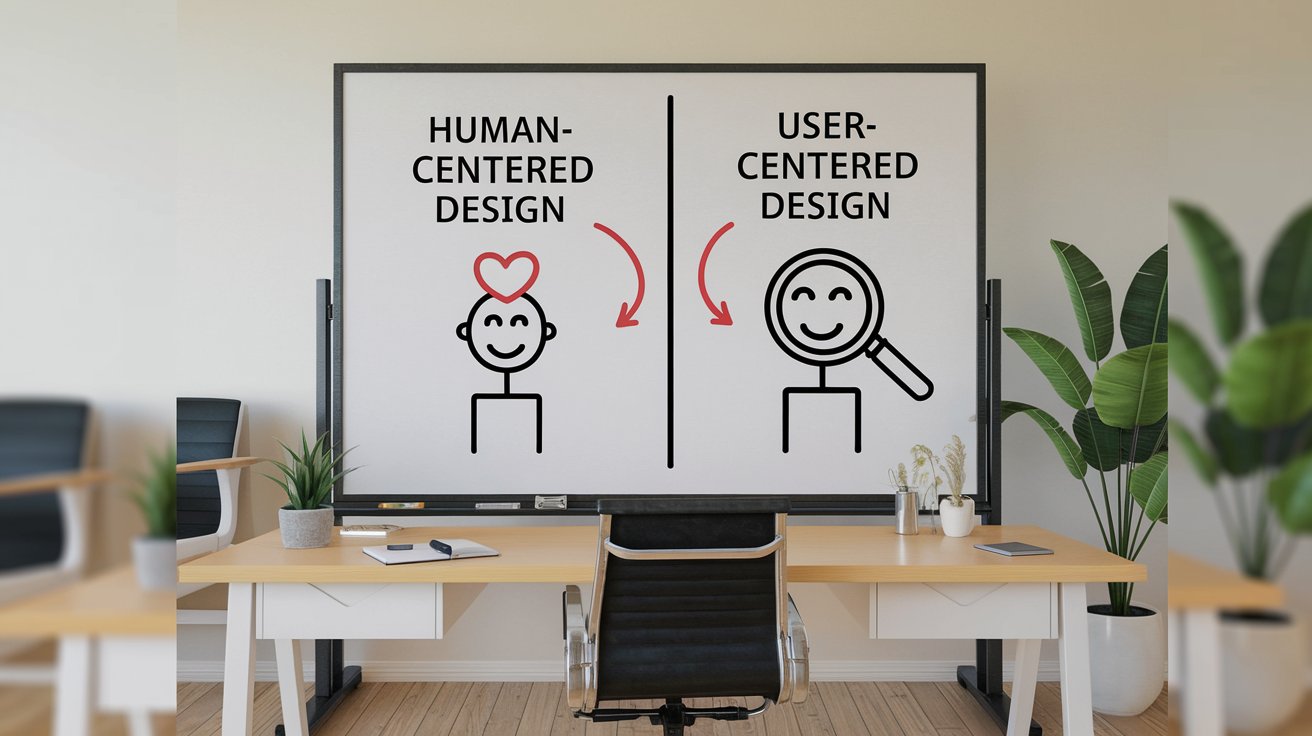
While often used interchangeably, human-centered design and design thinking have distinct characteristics. Design thinking is a broader problem-solving methodology that can be applied to any challenge, from business strategy to organizational change. It encompasses five stages: empathize, define, ideate, prototype, and test. Human-centered design, on the other hand, specifically emphasizes the human element throughout the entire process, ensuring that people’s needs remain the primary focus rather than just one consideration among many.
The key distinction lies in scope and application. Design thinking frameworks provide structured processes that teams can follow, while HCD represents a mindset and philosophy that influences how those processes are executed. In practice, the most successful organizations combine both: they use design thinking methodologies while maintaining an unwavering commitment to human-centered principles. According to 2026 research from the Design Management Institute, companies that integrate both approaches show 228% higher returns than those using traditional business methods, demonstrating that human focus combined with systematic thinking creates superior outcomes.
The Three Stages of Human-Centered Design
The human-centered design process follows three fundamental stages that guide teams from initial research to final implementation. These phases—inspiration, ideation, and implementation—create a structured yet flexible framework that adapts to different contexts while maintaining focus on human needs.
Inspiration: Understanding Human Needs
The inspiration phase involves deep immersion into the lives, contexts, and challenges of the people you’re designing for. This stage prioritizes observation, interviews, and ethnographic research to uncover both explicit needs and latent desires that people themselves may not articulate. Teams conduct field research, engage in participatory observation, and build empathy through direct experience. In 2026, advanced tools like AI-assisted qualitative analysis help teams process thousands of hours of user interviews while maintaining the human nuances that make insights actionable.
Successful inspiration requires asking open-ended questions, observing behavior in natural contexts, and suspending assumptions about what solutions should look like. Organizations like Kaiser Permanente spend 60-80 hours in this phase for major projects, recognizing that thorough understanding prevents costly pivots later. The goal is not just collecting data but developing genuine empathy that informs every subsequent decision throughout the design process.
Ideation: Generating Human-Focused Solutions
The ideation phase transforms insights from research into concrete solution concepts. Teams use brainstorming techniques, creative workshops, and collaborative sessions to generate numerous possibilities without immediately judging feasibility. The emphasis remains on human needs identified during inspiration, ensuring that ideas address real problems rather than imagined ones. Techniques like crazy eights, storyboarding, and bodystorming help teams explore diverse approaches while keeping people’s experiences central.
During ideation, quantity precedes quality—teams typically generate 100+ ideas before narrowing to the most promising concepts. The 2026 best practice involves including actual users in ideation sessions, recognizing that those experiencing challenges often contribute the most innovative solutions. Companies like Intuit have formalized co-creation workshops where customers and designers collaborate, resulting in products that achieve 40% higher market adoption rates compared to internally-developed alternatives.
Implementation: Testing and Refining With Real People
The implementation phase brings ideas to life through rapid prototyping and iterative testing with actual users. Rather than building complete solutions before gathering feedback, HCD emphasizes creating low-fidelity prototypes that allow quick learning and adaptation. Teams might use paper sketches, clickable wireframes, or physical mock-ups to test concepts with real people, gathering feedback that shapes subsequent iterations. This approach reduces development costs by identifying problems before significant resources are invested.
Modern implementation in 2026 combines traditional prototyping with digital simulation and virtual testing environments, allowing teams to gather feedback from geographically dispersed users. The key principle remains constant: test early, test often, and genuinely incorporate user feedback. Organizations following this approach report 64% fewer post-launch modifications, as human validation throughout implementation ensures the final solution meets actual needs. The phase concludes when solutions consistently demonstrate value in real-world contexts with the people they’re designed to serve.
Human-Centered Design Examples in Healthcare
Healthcare represents one of the most impactful domains for human-centered design, where understanding patient experiences directly influences health outcomes and quality of life. These examples demonstrate how HCD principles transform medical care delivery across the United States.
Kaiser Permanente’s Patient Room Redesign
Kaiser Permanente partnered with IDEO to completely reimagine hospital patient rooms by observing actual patient experiences, family behaviors, and staff workflows. The research revealed that family members felt helpless and in the way, while patients struggled with disorientation and lack of control. The resulting design included designated family zones, clearer wayfinding, and patient-accessible whiteboards for tracking care information. Implementation across Kaiser facilities led to a 32% reduction in patient falls and significantly improved satisfaction scores, demonstrating how understanding human needs creates measurable health improvements.
MRI Experience Redesign for Children
GE Healthcare recognized that pediatric MRI scans were traumatic experiences, with 80% of children requiring sedation due to anxiety. Through observing children’s reactions and understanding their perspectives, designers created the Adventure Series—MRI machines themed as pirate ships, camping adventures, and jungle expeditions. This human-centered redesign reduced pediatric sedation rates to just 10%, eliminated trauma for young patients, and decreased procedure times by 15%. The example shows how empathy for a specific population’s emotional needs creates breakthrough solutions that serve medical, financial, and human objectives simultaneously.
Human-Centered Design Examples in Daily Life
The most successful human-centered design examples often become so integrated into daily routines that their thoughtful design becomes invisible. These everyday examples demonstrate how HCD principles solve common challenges Americans encounter regularly.
OXO Good Grips Kitchen Tools
OXO’s founding story exemplifies human-centered design in consumer products. Founder Sam Farber watched his wife, who had arthritis, struggle with traditional kitchen peelers. Rather than creating a medical device, OXO designed ergonomic tools that work better for everyone—those with arthritis, younger users, and professional chefs alike. The distinctive rubber grips and thoughtful weight distribution emerged from extensive observation and testing with diverse users. By 2026, OXO’s human-centered approach has expanded to over 1,000 products, generating $300 million annually and proving that designing for specific human challenges creates universal benefits.
Apple’s iPhone Interface Design
Apple’s iPhone revolutionized mobile technology by prioritizing intuitive human interaction over technical specifications. The multi-touch interface emerged from observing how people naturally gesture and interact with objects. Features like pinch-to-zoom weren’t technically necessary—alternatives existed—but they matched human instincts. The human-centered design philosophy extended to app iconography, notification systems, and even the physical device curvature that fits comfortably in hands of various sizes. This relentless focus on human experience has made Apple the world’s most valuable company, with iPhone users showing 92% satisfaction rates in 2026 surveys, demonstrating that human-centered design drives both adoption and loyalty.
Human-Centered Design Examples in Business
Business applications of human-centered design extend beyond customer-facing products to internal processes, employee experiences, and service delivery models. These examples show how HCD principles drive competitive advantage and organizational success.
Airbnb’s Host and Guest Experience
When Airbnb faced stagnating growth in 2009, founders took a human-centered approach by personally visiting hosts and guests to understand their experiences. They discovered that poor photography made listings unappealing, but more importantly, that both hosts and guests craved connection and trust-building mechanisms. The resulting platform redesign emphasized verified profiles, detailed reviews, and photography standards that showcase authentic experiences rather than just accommodations. By 2026, Airbnb’s human-centered methodology has created a $75 billion company, with 68% of users citing the personal connection and authentic experiences as primary reasons they choose Airbnb over traditional hotels.
Bank of America’s Keep the Change Program
Bank of America developed Keep the Change by observing how people actually handle money rather than how financial theory suggests they should. Researchers noticed that many people save spare change in jars, a behavior that felt painless and rewarding. The program automatically rounds up debit card purchases to the nearest dollar, transferring the difference to savings. This human-centered design solution aligned with natural money behaviors rather than fighting them. The program attracted 12.3 million participants by 2026, helping Americans save over $2 billion collectively, and demonstrating how understanding human psychology creates financial products that genuinely improve lives.
Human-Centered Design Examples in Architecture
Architectural applications of human-centered design create spaces that enhance how people live, work, and interact. These examples demonstrate how understanding human behavior shapes the built environment across the United States.
The High Line Park in New York City
The transformation of Manhattan’s abandoned elevated railway into The High Line exemplifies human-centered urban design. Rather than demolishing the structure, designers observed how New Yorkers actually used urban spaces—seeking nature, social interaction, and respite from street-level chaos. The resulting design preserved the railway’s industrial character while creating varied seating areas, native plantings, and sight lines that encourage both solitude and community. Since opening, The High Line has attracted over 8 million annual visitors, increased surrounding property values by 103%, and inspired 25 similar projects nationwide, proving that designing for human experiences creates economic and social value beyond the immediate project.
Maggie’s Cancer Care Centers
Maggie’s Centers across the United States represent human-centered healthcare architecture that addresses the emotional and psychological needs of cancer patients. Through extensive research with patients, architects discovered that traditional medical environments increased anxiety when people most needed comfort. The centers feature residential-scale rooms, abundant natural light, kitchen tables for informal conversations, and gardens for reflection. Each design element emerged from understanding how cancer patients and families actually experience their journey. The human-centered approach has resulted in measurably reduced anxiety levels, with 89% of visitors reporting improved mental wellbeing, demonstrating that architecture profoundly impacts health outcomes when designed around human needs.
Famous Human-Centered Design Case Studies
These renowned HCD case studies have become teaching examples in design schools and business programs, illustrating how human-centered approaches solve complex challenges and create market-leading solutions.
IDEO’s Shopping Cart Redesign
IDEO’s shopping cart project, featured in the documentary “The Deep Dive,” became the definitive human-centered design case study. The team spent days observing shoppers, store employees, and maintenance workers to understand shopping cart pain points. They discovered that parents wanted child safety, stores needed easier maintenance, and shoppers wanted better maneuverability. The resulting prototype featured modular baskets, improved steering, and child-safe seating. While never mass-produced, this project demonstrated the HCD process to millions and established methodologies now used globally. The case study has been taught in over 500 universities, influencing how an entire generation approaches problem-solving.
Embrace Infant Warmer
Stanford students created the Embrace Infant Warmer by understanding that traditional incubators were inaccessible in developing regions, but also recognizing that American premature infant care faced similar challenges in rural areas. The team observed neonatal care in multiple contexts, discovering that cost, portability, and power requirements were universal barriers. The resulting sleeping-bag design with phase-change material maintains optimal temperature for four hours without electricity, costs $200 versus $20,000 for traditional incubators, and works in any setting. By 2026, Embrace has saved over 475,000 infant lives globally and is used in 36 rural American hospitals, proving that human-centered design for one context often creates solutions with universal application.
Core Principles of Human-Centered Design
Successful human-centered design implementation relies on foundational principles that guide teams through the creative process while maintaining focus on human needs and experiences.
Empathy as the Foundation
Empathy distinguishes human-centered design from other methodologies by requiring designers to genuinely understand and share the feelings of those they’re designing for. This goes beyond sympathy or market research—it demands direct engagement, observation in natural contexts, and suspending personal assumptions. Organizations practicing true empathy conduct immersive research where designers experience challenges firsthand. For example, when designing for visually impaired users, team members navigate spaces blindfolded. When creating senior-focused products, designers wear suits that simulate age-related mobility restrictions. This experiential empathy generates insights that surveys and focus groups cannot capture, leading to solutions that address real human needs rather than perceived ones.
Iterative Learning and Adaptation
Human-centered design embraces iteration as a core principle, recognizing that initial solutions rarely fully address complex human needs. Teams create multiple prototypes, test with real users, gather feedback, and refine continuously. This approach contrasts with traditional development cycles that invest heavily before validating with actual users. Rapid iteration reduces risk by identifying problems early when changes cost less. In 2026, leading organizations conduct 15-20 iteration cycles during typical product development, compared to 3-4 cycles in traditional approaches. Research shows that products undergoing extensive iteration achieve 54% higher user satisfaction and 38% faster market adoption, demonstrating that learning from real human feedback creates superior outcomes.
Collaboration Across Disciplines
Human-centered design thrives on diverse perspectives working together throughout the process. Effective teams include designers, engineers, business strategists, and most importantly, the people being designed for as active collaborators. This multidisciplinary approach ensures that solutions address human needs while remaining technically feasible and economically viable. Organizations like Mayo Clinic assemble teams with 8-12 different specialties for major HCD projects, recognizing that complex human challenges require varied expertise. The collaborative principle also emphasizes flat hierarchies where the best idea wins regardless of source, creating environments where frontline workers and users contribute equally with executives and designers.
Human-Centered Design in Government Services
Government agencies across the United States have adopted human-centered design principles to improve public services, increase accessibility, and enhance citizen experiences with essential programs.
U.S. Digital Service and Login.gov
The U.S. Digital Service applied human-centered design to federal identity verification by researching how citizens actually interact with government services. They discovered that Americans were managing dozens of different usernames and passwords for various federal agencies, creating security risks and abandonment. Login.gov emerged as a single sign-on solution designed around user behavior patterns rather than agency bureaucratic structures. The system prioritizes security while maintaining simplicity, using progressive disclosure to guide users through verification without overwhelming them. By 2026, Login.gov serves 78 million Americans accessing services from 47 federal agencies, reducing login-related support calls by 67% and demonstrating that government services can be both secure and user-friendly when designed around human needs.
California’s Benefits Enrollment Redesign
California redesigned its public benefits enrollment by observing how low-income families actually navigated social services. Researchers discovered that complex forms, unclear eligibility requirements, and siloed agency processes created barriers that prevented eligible families from receiving assistance. The human-centered redesign simplified language, created mobile-accessible applications, and integrated multiple benefit programs into unified experiences. Implementation resulted in a 43% increase in successful enrollments and reduced processing times from 45 days to 7 days. Most significantly, the design included pathways for caseworkers to connect families with comprehensive support rather than single programs, recognizing that human needs don’t align with bureaucratic divisions. The California example has influenced benefits redesigns in 18 other states.
Human-Centered Design Tools and Methods
Practitioners employ specific tools and methods to implement human-centered design principles effectively across different contexts and challenges.
Journey Mapping and Service Blueprints
Journey maps visualize complete user experiences across all touchpoints with a product, service, or organization. These tools document actions, emotions, pain points, and opportunities from the human perspective rather than organizational workflows. Service blueprints extend journey maps by connecting user experiences with behind-the-scenes processes, revealing where organizational structures misalign with human needs. In 2026, advanced journey mapping incorporates real-time data from IoT devices and behavioral analytics, creating dynamic maps that update as user patterns change. Organizations using journey mapping report identifying 3-5 times more improvement opportunities compared to traditional process analysis, as the tool reveals emotional and experiential gaps that operational metrics miss.
Participatory Design Workshops
Participatory design invites users directly into the creation process as co-designers rather than passive research subjects. These workshops provide materials, facilitation, and creative exercises that enable people to express needs, envision solutions, and prototype ideas themselves. Techniques include collage-making to express desired experiences, roleplay to explore service scenarios, and collaborative sketching to visualize product concepts. The method is particularly powerful when designing for communities different from the design team, as it shifts power dynamics and ensures solutions reflect authentic community values. Research shows that products developed through participatory design achieve 72% higher adoption within target communities, as people embrace solutions they helped create.
Measuring Human-Centered Design Impact
Organizations increasingly demand quantifiable evidence that human-centered design delivers results. These metrics and approaches demonstrate HCD’s business value and social impact.
User Satisfaction and Net Promoter Scores
User satisfaction metrics provide direct feedback on how well solutions meet human needs. Net Promoter Score (NPS), which measures likelihood to recommend, correlates strongly with business growth and has become a standard HCD outcome measure. Products developed through rigorous human-centered processes average NPS of 45-60, compared to 15-25 for traditionally developed alternatives. Organizations track satisfaction across the entire user journey, identifying specific touchpoints that delight or frustrate. In 2026, real-time satisfaction monitoring through embedded feedback mechanisms allows teams to identify and address issues within hours rather than waiting for quarterly surveys, enabling continuous improvement aligned with evolving human needs.
Time-to-Value and Adoption Rates
Human-centered design reduces time-to-value—the period between when someone starts using a solution and when they realize meaningful benefit. Products designed around natural human behaviors require less training and onboarding, accelerating value realization. Studies show that HCD products achieve 50% user proficiency in 3-5 days compared to 12-18 days for traditionally designed alternatives. Adoption rates also improve significantly, with human-centered solutions reaching 60% target audience adoption within six months versus 25-30% for traditional approaches. These metrics matter financially: faster adoption and value realization reduce customer acquisition costs, improve retention, and accelerate revenue growth, providing clear ROI for human-centered design investments.
Common Human-Centered Design Mistakes to Avoid
Even well-intentioned teams make predictable mistakes when implementing human-centered design. Understanding these pitfalls helps organizations maintain authentic human focus throughout projects.
Confusing Users With Buyers
A critical mistake involves designing for purchasers rather than actual users, particularly in B2B contexts or products where decision-makers differ from end-users. Enterprise software frequently falls into this trap, prioritizing features that impress executives during sales presentations while creating frustrating experiences for employees who use the tools daily. Truly human-centered design requires identifying all stakeholders but prioritizing those who interact with the solution most frequently. In 2026, successful organizations conduct parallel research streams—understanding buyer needs for marketing and sales while designing actual products around end-user experiences. This dual focus ensures solutions sell effectively while delivering genuine value to the humans using them.
Stopping After Initial Research
Many teams conduct excellent inspiration-phase research but abandon human contact during ideation and implementation. They assume early insights remain valid throughout development, missing opportunities to test assumptions and adapt to feedback. Authentic human-centered design maintains continuous user engagement through all phases. Organizations should plan for 15-20% of project time spent in direct user contact across the entire timeline, not just at the beginning. Teams that maintain ongoing human connection throughout development identify critical issues 60% earlier than those conducting front-loaded research, preventing costly late-stage pivots and ensuring final solutions genuinely address the needs they set out to serve.
The Future of Human-Centered Design in 2026
As technology advances and societal challenges evolve, human-centered design adapts while maintaining its core commitment to understanding and serving human needs.
Artificial intelligence and machine learning are transforming HCD research capabilities, enabling analysis of qualitative data at unprecedented scale. AI tools process thousands of interview transcripts, identify pattern themes, and surface insights that manual analysis might miss. However, the most sophisticated organizations recognize that AI augments rather than replaces human empathy. Technology handles data processing while designers focus on interpretation, relationship-building, and nuanced understanding that machines cannot replicate. The integration of AI has reduced research timelines by 40% while improving insight quality, allowing teams to conduct more thorough human-centered research within typical project constraints.
Inclusive design has become inseparable from human-centered practice in 2026. Organizations recognize that designing for diverse abilities, backgrounds, and contexts creates better solutions for everyone. The 61 million Americans with disabilities represent a significant market whose needs often reveal universal design opportunities. Companies now routinely include users across ability spectrums in research and testing, discovering that accessible design improves experiences for all users. Voice interfaces developed for blind users benefit drivers; closed captions created for deaf users help people in noisy environments. This inclusive approach has become both an ethical imperative and a competitive advantage, as products designed for diversity capture broader markets.
Related video about human centered design examples
This video complements the article information with a practical visual demonstration.
Most asked questions about human centered design examples
What is an example of human-centered design in everyday life?
OXO Good Grips kitchen tools exemplify human-centered design in daily life. The company was founded after observing someone with arthritis struggle with traditional peelers. OXO designed ergonomic tools with soft rubber grips and balanced weight distribution that work better for everyone—those with limited hand strength, professional chefs, and everyday cooks. The human-centered approach focused on actual user struggles rather than just making products look different, resulting in over 1,000 products that have sold hundreds of millions of units by solving real human challenges in the kitchen.
What are the 4 stages of human-centered design?
While some frameworks identify four stages, the most widely recognized human-centered design process includes three core phases: inspiration, ideation, and implementation. The inspiration phase involves deep research to understand human needs through observation and interviews. Ideation transforms insights into solution concepts through brainstorming and creative collaboration. Implementation brings ideas to life through rapid prototyping and testing with real users. Some organizations add a fourth “evaluation” stage to assess long-term impact, but the fundamental HCD process centers on these three iterative phases that keep human needs at the forefront throughout development.
What is a real-life example of user-centered design in healthcare?
GE Healthcare’s Adventure Series MRI machines demonstrate user-centered design in healthcare. After observing that 80% of children required sedation for MRI scans due to anxiety and fear, GE redesigned the experience from the child’s perspective. They created MRI machines themed as pirate ships, camping adventures, and jungle expeditions, transforming a frightening medical procedure into an engaging experience. This human-centered redesign reduced pediatric sedation rates to just 10%, eliminated trauma for young patients, decreased procedure times by 15%, and improved image quality since children remained still voluntarily rather than through sedation.
What are some famous examples of human-centered design?
Apple’s iPhone represents one of the most famous human-centered design examples. The multi-touch interface was designed around natural human gestures like pinching and swiping rather than requiring users to learn complex commands. The entire device prioritized intuitive interaction over technical specifications, with features emerging from observing how people naturally interact with objects. Other famous examples include Airbnb’s platform redesign based on understanding both host and guest experiences, the Embrace Infant Warmer developed for resource-limited settings, and IDEO’s shopping cart redesign project that became the definitive case study teaching human-centered methodology to designers worldwide.
How does human-centered design differ from traditional product development?
Human-centered design starts with understanding people’s needs before defining solutions, while traditional development often begins with technical capabilities or business objectives. HCD involves direct observation, empathy-building, and continuous user engagement throughout the entire process. Traditional approaches might conduct market research at the beginning but then develop solutions in isolation, testing only near completion. Human-centered design emphasizes rapid prototyping and iterative testing with real users, identifying problems when changes are still inexpensive. This fundamental difference in approach explains why HCD products typically achieve 54% higher user satisfaction and 38% faster market adoption compared to traditionally developed alternatives.
What industries benefit most from human-centered design?
All industries benefit from human-centered design, but healthcare, financial services, government, and consumer products show particularly dramatic improvements. Healthcare applications directly impact patient outcomes, comfort, and treatment adherence. Financial services use HCD to create products that align with natural money behaviors rather than fighting human psychology. Government agencies apply human-centered principles to make essential services accessible to all citizens. Consumer products companies recognize that HCD creates competitive advantages in crowded markets. By 2026, over 73% of Fortune 500 companies across all sectors have integrated human-centered design frameworks, recognizing that understanding and serving human needs drives success regardless of industry.
| Human-Centered Design Aspect | Key Implementation Details | Measurable Benefits |
|---|---|---|
| Research & Empathy | Direct observation, immersive fieldwork, 60-80 hours minimum for major projects | 3-5x more improvement opportunities identified vs. traditional analysis |
| Iterative Testing | 15-20 prototype cycles with real users, low-fidelity rapid testing | 54% higher user satisfaction, 64% fewer post-launch modifications |
| Inclusive Design | Diverse user inclusion, accessibility-first approach, universal benefit focus | Broader market capture, improved experiences for all user segments |
| Cross-Functional Teams | 8-12 different specialties, flat hierarchies, user co-creation | 228% higher returns than traditional business methods (2026 data) |
| Time-to-Value | Natural behavior alignment, minimal training requirements | 50% proficiency in 3-5 days vs. 12-18 days traditional approaches |
| Adoption Rates | Continuous user engagement, authentic need alignment | 60% target adoption in 6 months vs. 25-30% traditional methods |