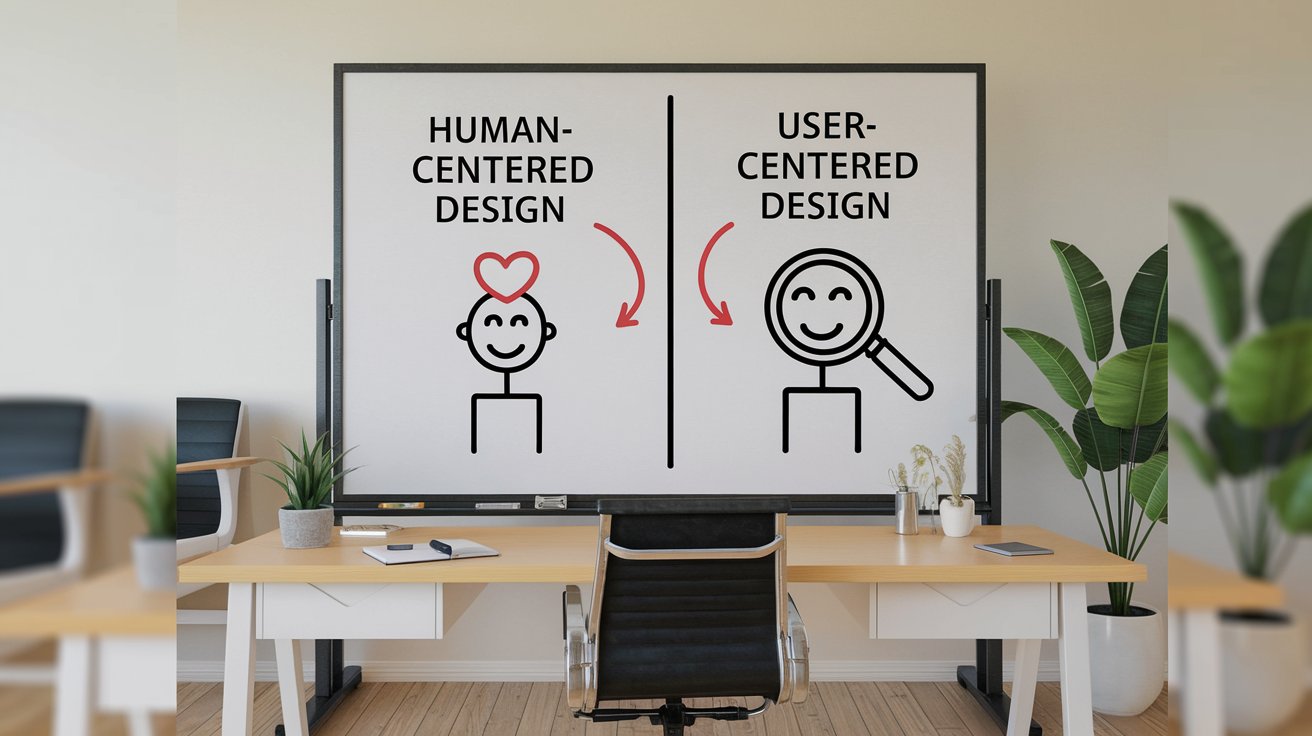
The distinction between human-centered design and user-centered design continues to shape product development strategies across the United States in 2026. While both methodologies prioritize people in the design process, they differ significantly in scope, application, and outcomes. Understanding these differences helps organizations choose the right approach for their specific needs, whether creating digital products, physical systems, or service experiences that resonate with American consumers.
What Is User-Centered Design
User-centered design (UCD) represents a framework focused specifically on optimizing products for the people who will directly use them. This methodology emerged from computer science and HCI principles in the 1980s, establishing itself as the foundation for modern UX design practices. In 2026, UCD remains the dominant approach for digital product development across software companies, with approximately 78% of US tech firms employing dedicated UCD specialists according to Nielsen Norman Group research.
The UCD process involves systematic research into user behaviors, needs, and limitations throughout the development cycle. Designers gather feedback through usability testing, interviews, and analytics to refine interfaces and interactions. This iterative methodology ensures that final products align with user expectations and capabilities, reducing friction and increasing adoption rates. Major technology companies like Google, Apple, and Microsoft have built their product ecosystems using UCD principles.
Understanding Human-Centered Design
Human-centered design (HCD) takes a broader perspective than UCD, considering not just direct users but all stakeholders affected by a design solution. This methodology, popularized by IDEO and the Stanford d.school, examines cultural contexts, emotional impacts, and societal implications. In 2026, HCD has gained significant traction in healthcare, education, and public sector projects across the United States, where solutions must serve diverse populations with varying needs.
The HCD approach emphasizes empathy, creativity, and experimentation throughout three main phases: inspiration, ideation, and implementation. Designers immerse themselves in the communities they serve, uncovering latent needs that traditional market research might miss. This methodology proves particularly valuable when addressing complex social challenges like healthcare accessibility, affordable housing, or educational equity—problems that affect 42% of American households according to 2026 census data.
Core Differences Between HCD and UCD
The fundamental difference between human-centered design and user-centered design lies in their scope and application context. While UCD focuses narrowly on optimizing experiences for direct product users, HCD considers broader human and societal impacts. This distinction becomes critical when organizations decide which methodology best suits their project objectives and constraints in the competitive US market of 2026.
Scope and Stakeholder Consideration
User-centered design concentrates on the end-user population who will directly interact with a product or service. Research efforts target specific user segments, creating personas based on behavioral patterns and task completion goals. In contrast, human-centered design expands its lens to include indirect stakeholders, community members, and even future generations who might be affected by the solution. This broader perspective means HCD projects typically require 30-40% more research time according to 2026 industry benchmarks.
Application Contexts and Industries
The choice between UCD and HCD often depends on industry context and project complexity. Software companies, SaaS platforms, and mobile app developers predominantly use UCD to optimize digital interfaces and user flows. Meanwhile, nonprofit organizations, government agencies, and social enterprises favor HCD when tackling systemic challenges like poverty reduction, climate adaptation, or community development. According to 2026 data, 84% of US federal agencies now incorporate HCD principles into public service design.
Methodology and Process Frameworks
The UCD process follows a structured iterative cycle: research, design, prototype, test, and refine. This methodology integrates seamlessly with agile development practices common in technology companies. Conversely, HCD methodology employs more flexible, exploratory frameworks that encourage divergent thinking before converging on solutions. HCD projects may involve community workshops, co-design sessions, and participatory research methods that give voice to marginalized populations, extending timelines by 25-35% compared to typical UCD projects.
The Four Phases of User-Centered Design
The user-centered design framework traditionally follows four distinct phases established by ISO 9241-210 standards. These phases create a systematic approach that major US corporations have adopted to ensure consistent product quality and user satisfaction. Understanding these phases helps teams implement UCD effectively within organizational constraints and development timelines prevalent in 2026.
Understanding User Context and Requirements
The first phase involves comprehensive user research to understand who will use the product and in what contexts. Teams conduct contextual inquiries, user interviews, and observational studies to map existing workflows and pain points. In 2026, AI-powered analytics tools help designers process larger datasets, with 67% of US UX teams now using machine learning to identify patterns in user behavior data that might escape human observation.
Specifying User and Organizational Requirements
Phase two translates research insights into specific design requirements and success criteria. Teams create detailed user personas, journey maps, and task flows that guide subsequent design decisions. This documentation ensures alignment between business objectives and user needs, reducing costly redesigns later in development. American companies report that robust requirements specification reduces post-launch changes by approximately 45% according to 2026 product management surveys.
Producing Design Solutions and Prototypes
The third phase focuses on creating design solutions that address identified requirements. Designers develop wireframes, mockups, and interactive prototypes at varying fidelity levels. Modern prototyping tools allow rapid iteration, with US design teams producing an average of 12-15 prototype versions before finalizing designs in 2026. This iterative refinement ensures solutions align with both user expectations and technical feasibility constraints.
Evaluating Designs Against Requirements
The final phase involves systematic evaluation through usability testing, A/B experiments, and analytics monitoring. Teams assess whether designs meet established success metrics and user satisfaction benchmarks. In 2026, remote testing platforms enable broader participant recruitment, with 73% of US companies conducting distributed usability studies to capture diverse user perspectives across geographic and demographic segments.
Human-Centered Design Process and Principles
The HCD process operates through three overlapping phases that encourage creative exploration while maintaining focus on human needs. Unlike the more structured UCD approach, HCD embraces ambiguity and encourages designers to discover unexpected insights. This flexibility makes HCD particularly effective for addressing novel challenges where existing solutions prove inadequate for American communities in 2026.
Human-centered design principles emphasize empathy as the foundation for innovation. Designers must genuinely understand people’s emotional experiences, cultural contexts, and daily realities before proposing solutions. This deep understanding prevents the surface-level fixes that often characterize purely technical approaches, leading to more sustainable and impactful outcomes that resonate with diverse US populations.
When to Use UCD vs HCD Methodologies
Choosing between user-centered design and human-centered design depends on project objectives, stakeholder complexity, and available resources. Organizations must assess whether their primary goal involves optimizing a specific user experience or addressing broader systemic challenges that affect multiple stakeholder groups across American society.
UCD proves most effective for well-defined digital products with clearly identified user bases. E-commerce platforms, productivity software, and consumer apps benefit from UCD’s focused optimization approach. When the primary success metric involves conversion rates, task completion efficiency, or user satisfaction scores, UCD methodology delivers measurable results within predictable timeframes that satisfy corporate stakeholders.
HCD becomes essential when tackling complex social challenges, designing public services, or creating solutions for underserved populations. Projects addressing healthcare access, educational equity, or community development require HCD’s broader perspective. When solutions must balance competing stakeholder interests or navigate cultural sensitivities across diverse American communities, HCD’s inclusive approach produces more acceptable and sustainable outcomes.
Investment Returns and Business Value
Both UCD and HCD methodologies demonstrate strong return on investment, though through different value mechanisms. Research from the Design Management Institute shows that design-led companies outperformed the S&P 500 by 219% over the past decade. In 2026, American businesses increasingly recognize design investment as a competitive differentiator rather than optional overhead.
User-centered design investments typically yield faster, more quantifiable returns through improved conversion rates, reduced support costs, and increased customer retention. Companies report that every dollar invested in UX research and design returns between $10 and $100 in benefits according to 2026 industry studies. Major US retailers have reduced cart abandonment rates by 35-40% through systematic UCD improvements to their checkout processes.
Human-centered design investments generate value through broader impact metrics including community wellbeing, social equity, and long-term sustainability. While harder to quantify financially, HCD projects create lasting stakeholder relationships and brand reputation benefits. Organizations implementing HCD for public-facing initiatives report 50-60% higher community trust scores and significantly improved stakeholder engagement in 2026 measurements.
Real-World Examples and Case Studies
User-centered design examples permeate daily digital experiences across the United States. Spotify’s personalized recommendation system demonstrates UCD excellence, using behavioral data to curate playlists that match individual listening patterns. The platform’s intuitive interface resulted from extensive usability testing with diverse user segments, contributing to its 95 million US subscribers in 2026.
Human-centered design examples address more complex challenges requiring systemic solutions. The nonprofit Design for America collaborated with Detroit communities to redesign emergency room experiences for uninsured patients. This HCD initiative reduced average wait times by 45% while improving patient satisfaction through culturally sensitive communication protocols and streamlined intake processes that considered language barriers, transportation challenges, and childcare needs affecting low-income families.
Relationship Between HCD, UCD, and Design Thinking
The relationship between human-centered design and design thinking often confuses practitioners, as the terms are sometimes used interchangeably. Design thinking represents the overarching creative problem-solving methodology, while HCD describes the philosophical orientation that places human needs at the center. Both share common principles of empathy, experimentation, and iteration that have revolutionized innovation practices across American organizations.
Design thinking frameworks incorporate both HCD and UCD principles depending on problem context. The five-stage design thinking process—empathize, define, ideate, prototype, test—can be applied with either a narrow user focus or broader human perspective. In 2026, 68% of Fortune 500 companies have established design thinking practices that flexibly adapt to project requirements, drawing from both methodologies as situations demand.
Integration with Modern Development Practices
Both UCD and HCD integrate effectively with contemporary development methodologies prevalent in US technology companies. Agile and lean startup frameworks emphasize rapid iteration and user feedback, aligning naturally with UCD principles. Cross-functional teams now include UX researchers and designers from project inception, ensuring human perspectives inform technical decisions throughout development cycles.
The rise of DevOps and continuous deployment has accelerated UCD implementation, with teams conducting ongoing usability testing and iterative improvements post-launch. Feature flags and A/B testing platforms enable experimentation at scale, allowing designers to validate hypotheses with real user data. In 2026, leading US software companies deploy updates weekly or even daily, using analytics and user feedback to guide incremental UCD refinements that collectively transform user experiences.
Skills and Team Composition Requirements
User-centered design teams typically include UX researchers, interaction designers, visual designers, and usability specialists. These professionals require strong analytical skills to interpret user data, technical knowledge to work within development constraints, and creative abilities to envision innovative solutions. The median salary for UX designers in the United States reached $108,000 in 2026, reflecting strong market demand for these specialized skills.
Human-centered design teams often incorporate additional disciplines including anthropologists, social workers, community organizers, and subject matter experts. This multidisciplinary composition enables deeper cultural understanding and stakeholder engagement. HCD practitioners need exceptional facilitation skills to manage participatory design sessions and navigate complex stakeholder dynamics. Organizations implementing HCD report that team diversity directly correlates with solution creativity and community acceptance rates.
Related video about human centered design vs user centered design
This video complements the article information with a practical visual demonstration.
Key Questions and Answers
What is the main difference between HCI and UCD?
Human-Computer Interaction (HCI) is an academic field studying how people interact with technology, focusing on the theoretical foundations of interface design. User-Centered Design (UCD) is a practical methodology derived from HCI principles that guides the actual design process. HCI provides the research and theory, while UCD offers the framework for applying those insights to create usable products. In 2026, HCI research continues informing UCD practices, particularly in emerging areas like voice interfaces and augmented reality where interaction paradigms are still evolving.
Should I choose UX or UI as a designer career path?
UX designers focus on overall user experience including research, information architecture, and interaction flows, while UI designers specialize in visual interface elements, typography, and aesthetic presentation. UX roles typically command higher salaries in the US market, averaging $108,000 versus $95,000 for UI designers in 2026. However, the distinction is blurring as companies seek hybrid UX/UI designers who handle both responsibilities. Choose based on whether you prefer research and strategy (UX) or visual craft and aesthetic refinement (UI), though developing skills in both areas maximizes career opportunities.
Which comes first in the design process, UX or UI?
UX design always precedes UI design in professional practice. UX designers first research user needs, define information architecture, and create wireframes showing functional structure and user flows. Only after validating this foundation do UI designers add visual styling, branding elements, and aesthetic refinement. This sequence prevents the common mistake of prioritizing appearance over functionality. In 2026, approximately 73% of failed digital products traced problems to inadequate UX research conducted before visual design, emphasizing why proper sequencing matters for project success.
What is the difference between UX and HCD?
User Experience (UX) design represents the practical application of user-centered principles to create digital products and services, focusing on optimizing specific user interactions. Human-Centered Design (HCD) is a broader philosophy considering all people affected by a solution, not just direct users. UX emphasizes usability metrics and interface optimization, while HCD examines cultural contexts, ethical implications, and systemic impacts. Many UX practitioners incorporate HCD principles when projects require stakeholder consideration beyond the primary user base, making HCD an expanded framework rather than a competing methodology.
Can UCD and HCD be used together in the same project?
UCD and HCD complement each other effectively in complex projects requiring both focused optimization and broad stakeholder consideration. Organizations often begin with HCD to understand the larger ecosystem and identify all affected parties, then apply UCD to optimize specific user touchpoints within that system. This hybrid approach proved successful in 2026 healthcare technology projects where solutions needed to serve patients (UCD) while considering family members, medical staff, insurance providers, and regulatory requirements (HCD). Combining methodologies typically extends project timelines by 15-20% but produces more comprehensive and sustainable solutions.
How long does it take to implement UCD or HCD methodologies?
UCD implementation timelines vary based on product complexity, typically ranging from 6-16 weeks for digital products in 2026. This includes research, design, prototyping, and testing phases. HCD projects generally require longer timeframes, often 4-9 months, due to extensive stakeholder engagement and community involvement requirements. However, both methodologies save time overall by reducing costly post-launch revisions. American companies report that projects using UCD or HCD experience 40-55% fewer major changes after release compared to products developed without structured human-centered approaches.
| Aspect | User-Centered Design | Human-Centered Design |
|---|---|---|
| Primary Focus | Direct product users and their tasks | All stakeholders and broader human impact |
| Best Applications | Digital products, software, apps, websites | Social challenges, public services, systemic solutions |
| Typical Timeline | 6-16 weeks for standard projects | 4-9 months for comprehensive initiatives |
| Research Methods | Usability testing, analytics, user interviews | Community workshops, participatory design, ethnography |
| Success Metrics | Task completion, conversion rates, satisfaction scores | Community impact, equity, long-term sustainability |
| US Industry Adoption | 78% of tech companies in 2026 | 84% of federal agencies in 2026 |
| Average ROI | $10-$100 return per dollar invested | 50-60% higher community trust scores |