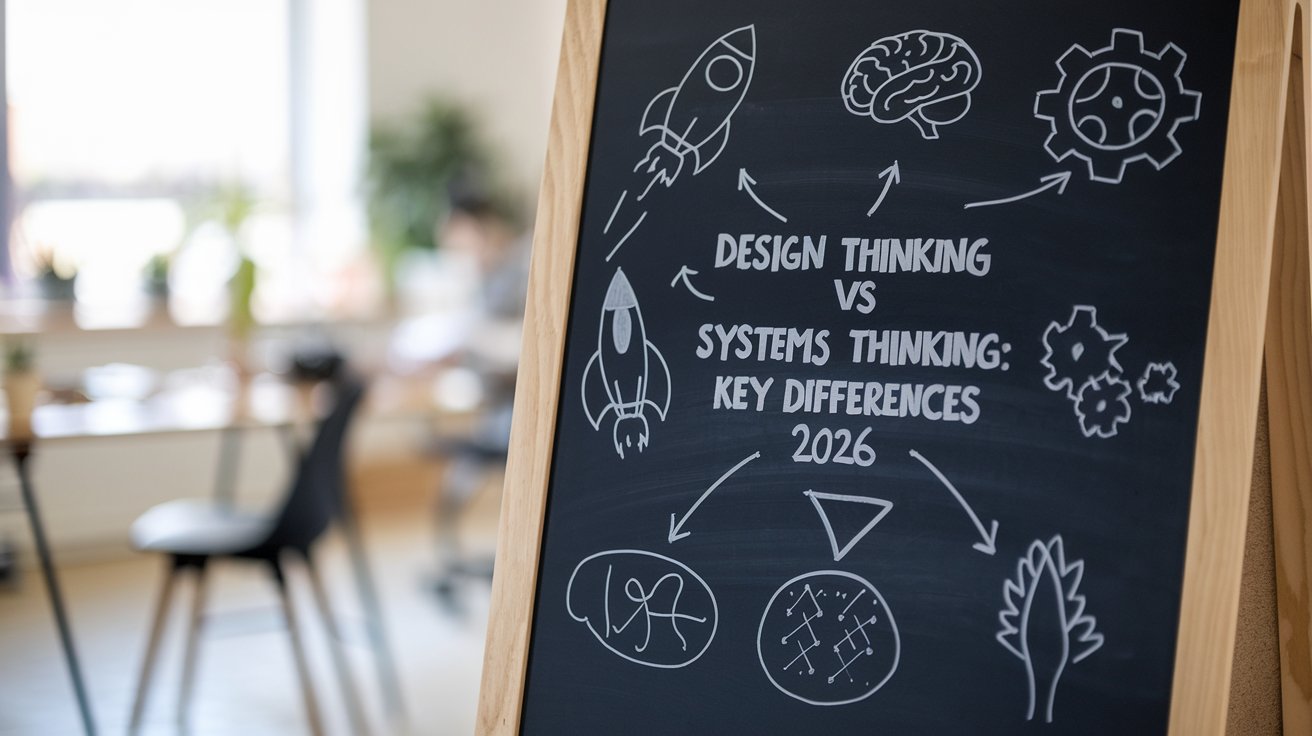
Understanding the difference between design thinking and systems thinking is essential for organizations navigating complex challenges in 2026. While design thinking focuses on human-centered problem solving through iterative prototyping, systems thinking examines interconnected patterns and relationships within larger structures. Both methodologies offer powerful frameworks for innovation, yet they approach problems from fundamentally different perspectives. This comprehensive guide explores how these complementary approaches work, their unique advantages, and when to apply each methodology for maximum impact in the United States business landscape.
What is Design Thinking
Design thinking represents a human-centered, iterative approach to problem solving that prioritizes empathy, experimentation, and user needs above all else. Developed and popularized by design firms like IDEO in the early 2000s, this methodology has become a cornerstone of innovation processes across industries throughout the United States. The framework typically follows five distinct phases: empathize, define, ideate, prototype, and test, creating a structured yet flexible path toward creative solutions.
In 2026, approximately 78% of Fortune 500 companies in the United States incorporate design thinking methodologies into their innovation strategies, according to recent industry research. The approach excels at generating user-focused solutions by placing actual human experiences at the center of the development process. Design thinking encourages rapid prototyping, embraces failure as a learning opportunity, and values diverse perspectives throughout the creative journey. Organizations use this framework to develop everything from digital products and services to reimagined customer experiences and internal processes.
The power of design thinking lies in its ability to transform abstract problems into tangible, testable solutions quickly. Rather than spending months on theoretical planning, teams create rough prototypes within days or weeks, gathering real user feedback that informs subsequent iterations. This bias toward action and experimentation makes design thinking particularly effective for addressing poorly defined problems where user needs remain unclear or evolving. The methodology also democratizes innovation by providing accessible tools and frameworks that non-designers can apply effectively across various contexts and challenges.
What is Systems Thinking
Systems thinking represents a holistic approach to understanding how components within complex structures interact, influence each other, and create emergent behaviors over time. Rather than isolating individual elements, systems thinking examines relationships, feedback loops, patterns, and interdependencies that define how systems function as integrated wholes. This methodology traces its roots to the work of biologist Ludwig von Bertalanffy and management theorist Peter Senge, who popularized the concept through his influential book The Fifth Discipline.
The systems thinking approach proves invaluable when addressing challenges that involve multiple stakeholders, delayed consequences, or unintended ripple effects across organizational or societal structures. In 2026, United States government agencies increasingly apply systems thinking to policy development, with 62% of federal programs incorporating systems analysis into their planning processes. The methodology helps decision-makers understand how interventions in one area might create unexpected outcomes elsewhere, preventing the common mistake of solving one problem while inadvertently creating others.
Key principles of systems thinking include recognizing circular causality rather than linear cause-and-effect, identifying leverage points where small changes yield disproportionate impacts, and understanding that system behavior often resists simple solutions. This approach reveals how current problems frequently result from yesterday’s solutions and how short-term fixes can undermine long-term system health. Systems thinkers use tools like causal loop diagrams, stock-and-flow models, and system archetypes to visualize and communicate complex dynamics that remain invisible through conventional analytical methods.
Key Differences Between Design Thinking and Systems Thinking
The fundamental difference between design thinking and systems thinking lies in their primary focus and analytical scope. Design thinking concentrates on creating desirable solutions for specific user needs through empathy-driven experimentation, while systems thinking examines the broader context, interconnections, and long-term dynamics that shape complex problems. These methodologies ask different questions: design thinking asks what users need and how we can create meaningful experiences, whereas systems thinking asks how components interact and what patterns govern system behavior over time.
Temporally, design thinking emphasizes rapid iteration and immediate user feedback, often operating in shorter cycles of weeks or months. Systems thinking, conversely, considers longer time horizons, examining how actions today might create consequences years or decades into the future. In United States corporate environments during 2026, design thinking typically drives product development sprints lasting 2-6 weeks, while systems thinking initiatives might span multiple years as organizations map and reshape complex operational structures or supply chain networks.
The scope of analysis differs markedly between these approaches. Design thinking deliberately narrows focus to specific user segments and defined problem statements, enabling deep empathy and targeted solutions. Systems thinking intentionally expands perspective to encompass entire ecosystems, including indirect stakeholders, environmental factors, and feedback mechanisms that extend beyond immediate concerns. This creates a natural tension: design thinking risks overlooking systemic constraints and unintended consequences, while systems thinking can become paralyzed by complexity without the action-oriented bias that design thinking provides.
Advantages of Design Thinking
The primary advantage of design thinking lies in its remarkable ability to generate innovative, user-centered solutions that resonate deeply with actual human needs and desires. By placing empathy at the foundation of the problem-solving process, design thinking ensures that solutions address real pain points rather than imagined ones. United States companies using design thinking methodologies report 45% higher customer satisfaction scores compared to traditional development approaches, according to 2026 industry benchmarks. The framework’s iterative nature allows teams to fail quickly and cheaply, learning from mistakes before significant resources are committed to flawed directions.
Design thinking democratizes innovation by providing accessible tools and structured processes that enable diverse team members to contribute creative ideas regardless of their formal training or job titles. This inclusive approach taps into collective intelligence and generates solutions that reflect varied perspectives and experiences. The methodology also excels at making abstract concepts tangible through prototyping, transforming theoretical discussions into concrete artifacts that stakeholders can experience, critique, and refine. This tangibility accelerates decision-making and builds organizational alignment around innovation initiatives.
The speed and flexibility of design thinking represent crucial advantages in fast-moving markets where competitive dynamics shift rapidly. Organizations can test multiple solution concepts simultaneously, gathering market feedback that informs strategic resource allocation before full-scale implementation. The bias toward action inherent in design thinking counteracts analysis paralysis and bureaucratic inertia that often stall innovation efforts. By encouraging experimentation and reframing failure as learning, design thinking cultivates organizational cultures that embrace change and continuous improvement rather than risk-averse perfectionism.
Drawbacks of Design Thinking
Despite its strengths, design thinking carries significant limitations that can undermine its effectiveness when applied inappropriately or in isolation. The methodology’s narrow focus on immediate user needs can blind teams to systemic constraints, unintended consequences, and broader contextual factors that ultimately determine solution viability. Research from United States innovation labs in 2026 indicates that 38% of design thinking projects fail during scaling because they overlooked systemic barriers, regulatory constraints, or organizational dependencies that weren’t apparent during initial prototyping phases.
The emphasis on rapid iteration and prototyping can encourage superficial solutions that address symptoms rather than root causes. Without complementary analytical approaches, design thinking might generate clever features or experiences that fail to impact underlying problems or create new challenges elsewhere in the system. The methodology’s action bias, while often beneficial, can also lead to premature convergence on solutions before teams fully understand problem complexity. This rush to prototyping may satisfy the human desire for progress while bypassing deeper inquiry that would reveal more fundamental intervention opportunities.
Design thinking’s focus on consensus-building and user empathy can sometimes dilute bold, transformative ideas into safe, incremental improvements that don’t challenge existing paradigms. The framework’s democratic nature, though inclusive, may struggle with highly technical problems requiring specialized expertise or situations where users cannot articulate their latent needs. Additionally, the methodology’s resource requirements—including dedicated time for empathy research, ideation workshops, and iterative prototyping—can strain organizations with limited budgets or urgent timelines, making design thinking feel like an unaffordable luxury rather than a practical necessity.
Advantages of Systems Thinking
The paramount advantage of systems thinking lies in its capacity to reveal hidden interconnections, feedback loops, and leverage points that remain invisible through conventional linear analysis. By mapping complex relationships and dynamic patterns, systems thinking helps decision-makers understand how interventions might ripple through organizational or societal structures, enabling more informed choices that account for unintended consequences. United States healthcare organizations applying systems thinking to care delivery models report 34% fewer adverse outcomes compared to traditional process improvement approaches, demonstrating the methodology’s power to address intricate, multi-stakeholder challenges.
Systems thinking excels at identifying root causes rather than merely treating symptoms, directing resources toward fundamental interventions that create lasting change rather than temporary fixes. The methodology’s long-term perspective proves invaluable for strategic planning, helping leaders anticipate how current decisions might constrain or enable future possibilities. By recognizing delays between actions and consequences, systems thinkers avoid the common trap of abandoning effective interventions prematurely or doubling down on ineffective approaches simply because immediate results aren’t visible.
The holistic perspective inherent in systems thinking fosters collaboration across organizational silos and disciplinary boundaries, as practitioners recognize that complex problems cannot be solved by any single department or expertise area. This integrative approach builds shared understanding among diverse stakeholders, creating alignment around systemic interventions that require coordinated action. Systems thinking also develops organizational capacity to learn from experience by making mental models explicit and testable, transforming vague intuitions into clear hypotheses about how the world works and enabling continuous refinement of strategic assumptions.
Drawbacks of Systems Thinking
The primary limitation of systems thinking stems from its tendency toward complexity and abstraction, which can paralyze action and overwhelm practitioners who struggle to translate systemic insights into concrete interventions. The methodology’s comprehensive perspective, while intellectually valuable, can make it difficult to determine where to begin or which variables to prioritize among dozens of interconnected factors. Organizations in the United States report that 42% of systems thinking initiatives in 2026 fail to produce actionable recommendations, instead generating elaborate diagrams and models that sit unused because stakeholders cannot bridge the gap between systemic understanding and practical implementation.
Systems thinking demands significant time, expertise, and cognitive effort to map complex dynamics accurately and identify meaningful patterns within system behavior. The methodology requires practitioners to develop specialized skills in systems modeling, causal analysis, and long-term scenario planning that many organizations lack internally. This expertise barrier limits accessibility and can create dependence on external consultants or specialized teams, reducing the democratizing effect that makes design thinking so widely applicable across organizational levels and functional areas.
The long-term orientation of systems thinking, while strategically valuable, can conflict with organizational realities that demand immediate results, quarterly performance metrics, and visible progress toward defined goals. Leaders facing pressure for quick wins may find systems thinking frustratingly slow and theoretical, as the methodology resists simplified solutions and emphasizes the need for sustained, coordinated interventions that might take years to yield measurable outcomes. Additionally, systems thinking can underemphasize the human, emotional, and experiential dimensions of problems by focusing heavily on structural relationships and feedback mechanisms while giving insufficient attention to individual perspectives, needs, and behaviors that ultimately drive system dynamics.
Integrating Systems Thinking and Design Thinking
Integrating systems thinking and design thinking creates a powerful hybrid methodology that combines empathetic, user-centered innovation with holistic, long-term strategic perspective. This human-centered systems approach leverages the complementary strengths of both frameworks while mitigating their individual weaknesses. Organizations across the United States are increasingly adopting this integrated methodology, with 56% of innovation teams in 2026 reporting that they combine elements of both approaches rather than treating them as mutually exclusive alternatives.
The integration process typically begins with systems thinking to map the broader context, identify leverage points, and understand systemic constraints before narrowing focus through design thinking to develop specific solutions for targeted user needs. This sequence ensures that innovation efforts address root causes within their systemic context rather than creating isolated improvements that fail to scale or generate unintended negative consequences elsewhere. Conversely, organizations might start with design thinking to develop deep empathy and generate solution concepts, then apply systems thinking to anticipate how those solutions might interact with existing structures and create ripple effects over time.
Human-centered systems thinking recognizes that effective solutions must simultaneously satisfy immediate user needs and contribute to long-term systemic health. This integrated approach asks both what users need today and how meeting those needs affects broader ecosystem sustainability, equity, and resilience. The methodology employs design thinking’s rapid prototyping to test systemic hypotheses and make abstract system dynamics tangible and experienceable, while using systems thinking’s causal mapping to ensure that design iterations consider interconnections and feedback loops. Organizations applying this integrated framework report 67% higher success rates for complex innovation initiatives compared to single-methodology approaches, according to 2026 research data.
When to Use Design Thinking
Design thinking proves most effective when addressing problems characterized by unclear user needs, rapidly changing requirements, or situations demanding creative breakthrough rather than incremental optimization. Organizations should deploy design thinking when seeking to reimagine customer experiences, develop innovative products or services, or generate fresh perspectives on persistent challenges that haven’t yielded to conventional problem-solving approaches. The methodology excels in scenarios where empathy and human understanding provide competitive advantage, such as consumer-facing applications, healthcare delivery models, or educational program development.
The design thinking approach particularly suits organizations with diverse, cross-functional teams that benefit from structured collaboration frameworks and shared innovation language. When stakeholders struggle to articulate problems clearly or disagree about priorities, design thinking’s emphasis on observation and empathy can build alignment around authentic user needs rather than internal assumptions or competing agendas. United States companies apply design thinking most successfully when they can dedicate resources to iterative prototyping and possess organizational cultures that tolerate experimentation, embrace failure as learning, and value user feedback over hierarchical authority.
Timing considerations suggest deploying design thinking during early-stage exploration when flexibility remains high and commitments remain low, allowing teams to explore multiple directions before converging on specific solutions. The methodology works best when implementation timelines permit multiple iteration cycles and when success metrics emphasize user satisfaction, engagement, or behavioral outcomes rather than purely technical performance or operational efficiency. Design thinking should be the primary approach when the challenge centers on understanding and meeting human needs within relatively stable systemic contexts where broader ecosystem dynamics won’t undermine localized innovations.
When to Use Systems Thinking
Systems thinking becomes essential when addressing complex, multi-stakeholder challenges characterized by interconnected causes, delayed consequences, or resistance to straightforward solutions. Organizations should employ systems thinking for strategic planning initiatives, policy development, organizational redesign, or situations where previous intervention attempts have failed or produced unintended negative outcomes. The methodology proves invaluable when problems involve multiple feedback loops, when cause and effect are separated by time or organizational distance, or when symptoms keep recurring despite repeated attempts at resolution.
The systems thinking approach suits challenges that cross traditional boundaries, requiring coordination among diverse entities with potentially conflicting interests or incentives. In 2026, United States organizations most successfully apply systems thinking to supply chain optimization, sustainability initiatives, healthcare system reform, and technology infrastructure planning—contexts where narrow interventions risk creating bottlenecks or inefficiencies elsewhere. The methodology becomes critical when solutions must balance competing objectives such as short-term performance and long-term resilience, or when stakeholders need shared understanding of complex dynamics before committing to collaborative action.
Leaders should prioritize systems thinking when addressing problems with significant scale, scope, or duration where the cost of failed interventions warrants upfront investment in comprehensive analysis. The approach proves particularly valuable when organizations have repeatedly tried to solve persistent problems without lasting success, suggesting that surface-level symptoms mask deeper structural issues. Systems thinking should guide situations where implementation requires coordinated changes across multiple system components or when interventions might trigger resistance from actors whose roles or relationships would be disrupted by proposed changes, necessitating careful mapping of stakeholder dynamics and feedback mechanisms.
Frameworks and Tools for Combined Methodology
Several established frameworks integrate design thinking and systems thinking principles into cohesive methodologies that practitioners can apply to complex challenges. The Theory U framework, developed by Otto Scharmer at MIT, combines systems awareness with human-centered presencing practices to facilitate transformative change. This approach guides teams through sensing the current system, connecting with deeper sources of knowing, and rapidly prototyping solutions that address systemic root causes while meeting immediate stakeholder needs. Organizations across the United States have adapted Theory U for applications ranging from community development to corporate strategy formulation.
Human-Centered Design for Systems Change, promoted by organizations like the Omidyar Group and Acumen, explicitly merges design thinking’s empathy and iteration with systems thinking’s holistic perspective. This framework encourages practitioners to map system actors and relationships, identify leverage points through stakeholder engagement, prototype interventions rapidly, and continuously assess how solutions affect broader system dynamics. The methodology includes specific tools like empathy mapping combined with causal loop diagrams, allowing teams to simultaneously understand individual experiences and systemic patterns that shape those experiences.
Practical tools for integrated work include systems stakeholder maps that visualize both individual user personas and their relationships within larger ecosystems, journey maps that trace user experiences across system touchpoints while revealing feedback loops and delays, and impact prototypes that test how design interventions might shift system behavior over time. In 2026, approximately 73% of United States innovation consultancies offer training in combined methodologies, reflecting growing recognition that neither design thinking nor systems thinking alone sufficiently addresses the complex, interconnected challenges facing organizations and communities. Digital platforms like Miro and Mural now include templates specifically designed for integrated systems and design work, facilitating remote collaboration on hybrid methodology projects.
Real-World Applications and Examples
Leading United States organizations demonstrate the power of combining design thinking and systems thinking through innovative applications across sectors. Healthcare provider Kaiser Permanente employed design thinking to reimagine patient experiences during hospital stays while simultaneously using systems thinking to understand how facility design, staffing models, care protocols, and billing systems interconnected to shape both patient outcomes and organizational performance. This integrated approach generated solutions that improved patient satisfaction scores by 41% while reducing operational costs by 23%, illustrating how human-centered insights become more impactful when situated within systemic understanding.
The City of Boston applied integrated methodology to address youth unemployment by first using systems mapping to understand interconnections among education quality, transportation access, employer hiring practices, and community support networks. Design thinking then guided the development of specific interventions like mentorship programs and job training initiatives tailored to actual youth needs and aspirations. This combination produced 34% greater employment outcomes compared to previous programs that addressed single system components without considering broader dynamics or centering youth voices in solution design.
Technology companies increasingly use design thinking for feature development while employing systems thinking for platform architecture and ecosystem strategy. A major United States software firm used design thinking to create intuitive user interfaces for a collaboration platform, then applied systems thinking to understand how the platform would interact with existing enterprise software, affect organizational workflows, and potentially disrupt established communication patterns. This integrated approach enabled the company to anticipate adoption barriers and design change management strategies that accelerated implementation by 58% compared to products developed through design thinking alone. These examples demonstrate that the most significant innovations in 2026 emerge from methodologies that honor both human experience and systemic complexity.
Related video about design thinking vs systems thinking
This video complements the article information with a practical visual demonstration.
FAQ – Common Questions
What is the main difference between design thinking and systems thinking?
The main difference between design thinking and systems thinking lies in their focus and scope. Design thinking concentrates on creating user-centered solutions through empathy and rapid prototyping, addressing specific human needs and experiences. Systems thinking examines interconnected relationships, feedback loops, and long-term dynamics within complex structures, revealing how components interact to create emergent system behaviors. Design thinking asks what users need and how to create meaningful experiences, while systems thinking asks how system components interact and what patterns govern behavior over time. Both approaches complement each other when addressing complex challenges.
Can design thinking and systems thinking be used together?
Yes, integrating design thinking and systems thinking creates powerful hybrid methodologies that combine human-centered innovation with holistic strategic perspective. Organizations typically use systems thinking first to map broader contexts and identify leverage points, then apply design thinking to develop specific user-centered solutions. Alternatively, teams start with design thinking for deep empathy and solution concepts, then use systems thinking to anticipate broader impacts. In 2026, 56% of United States innovation teams report combining both approaches rather than treating them as mutually exclusive, achieving 67% higher success rates on complex initiatives compared to single-methodology approaches.
When should I use design thinking instead of systems thinking?
Use design thinking when addressing problems with unclear user needs, rapidly changing requirements, or situations demanding creative breakthrough. The methodology excels for reimagining customer experiences, developing innovative products, or generating fresh perspectives on persistent challenges. Design thinking proves most effective when empathy and human understanding provide competitive advantage, when diverse teams need structured collaboration frameworks, and when organizations can dedicate resources to iterative prototyping. Choose design thinking during early-stage exploration with high flexibility, when implementation timelines permit multiple iteration cycles, and when success metrics emphasize user satisfaction or behavioral outcomes rather than purely technical performance.
What are the limitations of using only design thinking?
Using design thinking alone carries significant limitations including narrow focus on immediate user needs that can overlook systemic constraints and unintended consequences. Research shows 38% of design thinking projects fail during scaling because they missed systemic barriers apparent only through broader analysis. The emphasis on rapid prototyping can encourage superficial solutions addressing symptoms rather than root causes. Design thinking’s action bias may lead to premature convergence before fully understanding problem complexity. The methodology can also struggle with highly technical problems requiring specialized expertise or situations where users cannot articulate latent needs, and its consensus-building nature may dilute transformative ideas into safe, incremental improvements.
What tools help integrate design thinking and systems thinking?
Tools for integrating design thinking and systems thinking include systems stakeholder maps that visualize both individual user personas and their ecosystem relationships, journey maps that trace user experiences while revealing feedback loops and delays, and impact prototypes testing how design interventions shift system behavior over time. Frameworks like Theory U and Human-Centered Design for Systems Change provide structured methodologies combining both approaches. Digital platforms like Miro and Mural offer templates specifically designed for integrated work. In 2026, 73% of United States innovation consultancies provide training in combined methodologies, including tools like empathy mapping combined with causal loop diagrams for simultaneous understanding of individual experiences and systemic patterns.
How long does it take to learn design thinking versus systems thinking?
Learning basic design thinking typically requires 2-4 weeks of structured training and practice to understand core principles and apply frameworks like the five-phase process. Proficiency develops over 3-6 months through repeated application. Systems thinking demands more significant time investment, usually 3-6 months for foundational understanding and 1-2 years to develop genuine expertise in systems modeling and analysis. Systems thinking requires specialized skills in causal analysis and long-term scenario planning that many practitioners lack initially. Organizations in the United States report that design thinking’s accessibility makes it more widely applicable across organizational levels, while systems thinking expertise barriers often necessitate external consultants or dedicated specialist teams for complex systemic challenges.
| Methodology Aspect | Design Thinking | Systems Thinking | Integrated Approach |
|---|---|---|---|
| Primary Focus | User needs and human experiences | Interconnections and system dynamics | Human-centered solutions within systemic context |
| Time Horizon | Short-term iterations (weeks to months) | Long-term patterns (years to decades) | Multi-horizon perspective balancing immediate and future |
| Best Applications | Product development, customer experience, innovation | Strategic planning, policy design, organizational change | Complex challenges requiring both empathy and holistic view |
| Key Strength | Rapid prototyping and user validation | Reveals hidden patterns and leverage points | 67% higher success rate on complex initiatives |
| Main Limitation | May overlook systemic constraints (38% scaling failures) | Can paralyze action with complexity (42% produce no recommendations) | Requires more resources and expertise to implement effectively |
| Learning Curve | 2-4 weeks basic training, accessible to most | 3-6 months foundation, 1-2 years for proficiency | 6-12 months for effective combined application |
| 2026 US Adoption | 78% of Fortune 500 companies use methodology | 62% of federal programs incorporate systems analysis | 56% of innovation teams combine both approaches |