Understanding the difference between Design Thinking and Lean Startup is essential for product teams and entrepreneurs navigating innovation in 2026. While both methodologies emphasize user-centricity and iteration, they serve distinct purposes in the product development lifecycle. Design Thinking focuses on deep empathy and creative problem-solving to identify the right problems, while Lean Startup emphasizes rapid experimentation and validated learning to build sustainable business models. This comprehensive guide explores how these frameworks complement each other and when to apply each approach.
What is Design Thinking
Design Thinking is a human-centered approach to innovation that originated at Stanford University and has evolved significantly through 2026. This methodology prioritizes understanding user needs through empathy before generating solutions. The process helps teams tackle complex problems by focusing on what users actually need rather than what organizations assume they want. In the United States, over 73% of Fortune 500 companies now incorporate Design Thinking principles into their innovation processes.
The framework consists of five core phases that guide teams from problem discovery through solution implementation. Unlike traditional linear processes, Design Thinking encourages iteration and循環 thinking, allowing teams to revisit earlier stages as new insights emerge. This flexibility makes it particularly valuable for addressing ambiguous challenges where the problem itself may not be clearly defined at the outset.
The Five Stages of Design Thinking
The empathize design thinking stage requires teams to conduct deep user research through interviews, observations, and immersive experiences. In 2026, organizations use advanced ethnographic tools and AI-assisted analysis to uncover hidden user needs. The define stage synthesizes research findings into clear problem statements that guide solution development. During ideate, teams generate diverse solutions without judgment, typically producing 50-200 initial concepts for complex challenges.
The design thinking prototype phase involves creating low-fidelity representations of solutions, from paper sketches to clickable mockups. Current best practices in the United States emphasize rapid prototyping cycles of 2-5 days rather than weeks. Finally, design thinking testing brings prototypes to real users for feedback, with successful teams conducting 15-30 user tests per iteration cycle to validate assumptions and refine solutions.
When to Use Design Thinking
Design Thinking excels when facing undefined problems, exploring new market opportunities, or reimagining existing experiences. Organizations apply this methodology when they need to understand complex user behaviors or when traditional solutions have failed to address underlying needs. In 2026, design thinking tutorial programs emphasize its value for digital transformation initiatives, where understanding human factors determines success or failure.
The approach proves particularly effective for cross-functional teams tackling systemic challenges that span multiple departments or stakeholder groups. Companies in the United States report 58% higher innovation success rates when using Design Thinking for early-stage exploration compared to traditional methods. However, this methodology requires significant time investment in the empathy and research phases, typically 4-8 weeks for comprehensive problem exploration.
What is Lean Startup
The Lean Startup methodology, refined extensively since its introduction, focuses on building sustainable businesses through validated learning and scientific experimentation. This approach emphasizes reducing waste by testing business hypotheses before investing significant resources in full-scale development. In 2026, Lean Startup principles guide over 80% of venture-backed startups in the United States, reflecting its proven track record for reducing failure rates.
At its core, Lean Startup challenges entrepreneurs to validate assumptions about customers, pricing, distribution, and product features through real market experiments rather than theoretical business plans. The methodology draws inspiration from lean manufacturing and applies kaizen principles of continuous improvement to entrepreneurship. By prioritizing learning over execution, teams avoid building products nobody wants, which accounts for 42% of startup failures according to 2026 data.
The 5 Principles of Lean Startup
The first principle states that entrepreneurs are everywhere, not just in garages or tech hubs, expanding the methodology’s applicability across industries and organizational types. The second principle defines entrepreneurship as management, requiring appropriate processes and accountability structures. Validated learning forms the third principle, emphasizing empirical data over vanity metrics or theoretical projections.
The fourth principle introduces the Build-Measure-Learn feedback loop as the fundamental activity of startups, where speed of iteration determines competitive advantage. In 2026, successful teams complete this cycle in 1-2 weeks rather than months. The fifth principle advocates for innovation accounting, using actionable metrics to track progress, prioritize work, and make data-driven decisions. Companies applying these principles report 67% faster time-to-market compared to traditional development approaches.
Lean Process for a Better Product
The lean process begins with identifying the riskiest assumptions about your business model and designing minimum viable products to test them. Rather than building complete features, teams create the simplest version that enables learning, often launching with 20-30% of initially planned functionality. This approach, central to stanford lean startup teachings, reduces development costs by 50-70% during validation phases.
Teams measure results using cohort analysis, split testing, and funnel metrics to understand actual user behavior rather than stated preferences. The lean methodology also incorporates pivot or persevere decisions at regular intervals, typically every 6-8 weeks, where teams objectively assess whether current strategies merit continuation or require fundamental changes. In 2026, artificial intelligence tools help identify patterns in user data, accelerating the measurement and learning phases significantly.
Design Thinking vs Lean Startup: Core Differences
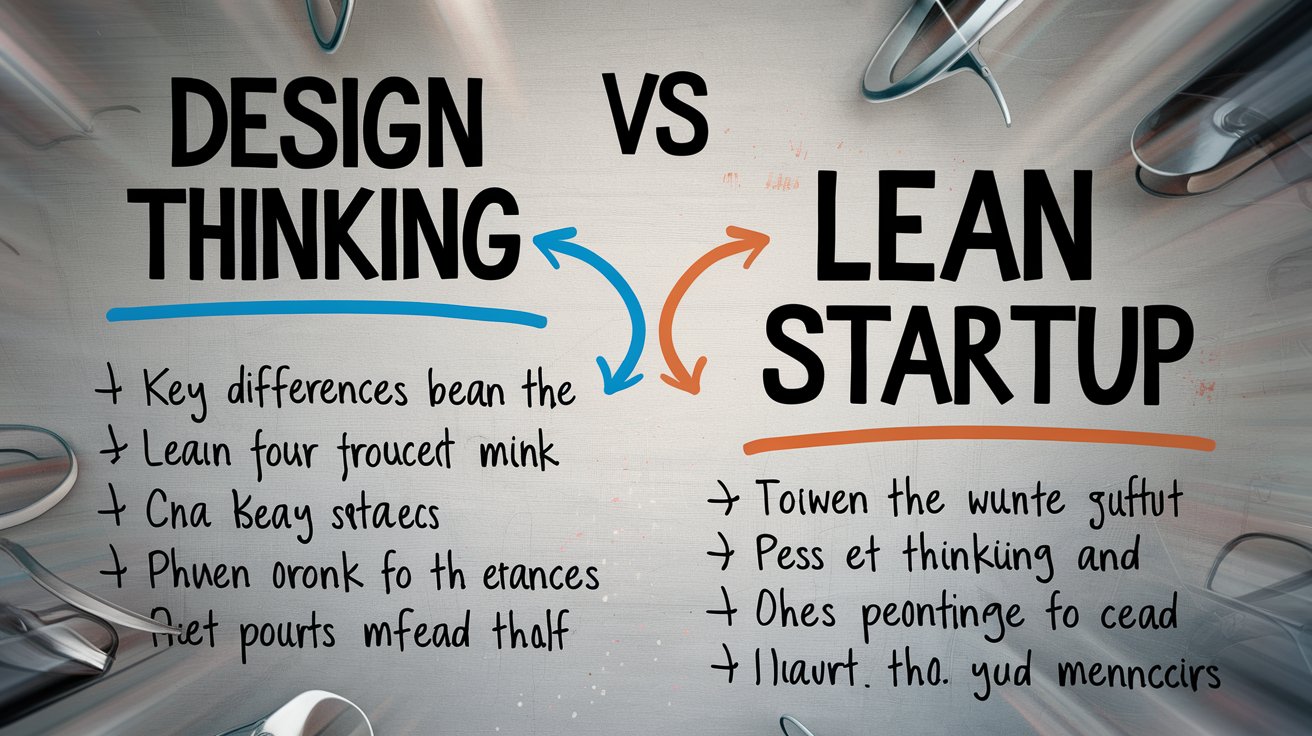
The fundamental difference between Design Thinking and Lean Startup lies in their primary focus and application timing. Design Thinking excels at problem discovery and solution ideation, asking ‘what should we build?’ before committing to development. Conversely, Lean Startup focuses on business model validation and market fit, asking ‘should we build this?’ and ‘can this be a sustainable business?’ These distinct purposes make them complementary rather than competing methodologies.
Another critical distinction involves their relationship with uncertainty. Design Thinking embraces ambiguity during problem exploration, often spending weeks understanding user contexts without clear solutions. Lean Startup treats uncertainty as risk to be eliminated quickly through market experiments and minimum viable products. In 2026, leading organizations in the United States combine both approaches, using Design Thinking for deep user understanding and Lean Startup for rapid market validation.
Design Thinking vs Lean Startup Examples
Consider a healthcare technology company exploring telemedicine solutions. Using design thinking examples, they spend six weeks conducting patient interviews, shadowing doctors, and mapping care journeys to identify critical pain points. This empathy work reveals that medication adherence, not appointment scheduling, represents the core challenge. The team then applies Design Thinking to prototype various reminder systems, testing concepts with 45 patients.
Transitioning to Lean Startup, the team builds a basic SMS reminder system as their minimum viable product, testing it with 200 patients over four weeks. They measure medication adherence rates, engagement metrics, and gather feedback to validate whether this solution merits full development. This design thinking vs lean startup example illustrates how Design Thinking identifies the right problem while Lean Startup validates whether the solution creates sustainable value. The combined approach reduces risk while maintaining user-centricity throughout development.
Design Thinking vs Lean Startup Pros and Cons
Design Thinking pros include deep user empathy, creative solution generation, and strong stakeholder alignment around user needs. This methodology excels at uncovering non-obvious insights and fostering innovation culture. However, Design Thinking can be time-intensive, requiring 6-12 weeks for thorough problem exploration, and may generate solutions that aren’t technically or commercially viable without additional validation.
Lean Startup pros encompass rapid learning cycles, efficient resource utilization, and clear metrics for decision-making. The methodology reduces financial risk by testing before building and provides concrete data for stakeholder communication. The cons include potential for incremental rather than breakthrough innovation, overemphasis on quantitative metrics that miss qualitative insights, and possible neglect of deeper user needs in favor of measurable behaviors. In 2026, teams address these limitations by integrating both methodologies strategically.
Is Design Thinking a Lean Process
While Design Thinking shares some characteristics with lean methodologies, it is not inherently a lean process in the manufacturing sense. Both approaches value iteration, learning, and waste reduction, but they apply these principles differently. Design Thinking focuses on eliminating wasted effort on wrong problems, while traditional lean process methodologies target efficiency in execution and production.
The connection between Design Thinking and lean thinking lies in their shared emphasis on value creation from the user perspective. Both reject assumptions in favor of validation, though Design Thinking validates through empathy and prototyping while lean approaches validate through process optimization and waste elimination. In 2026, organizations increasingly recognize that Design Thinking complements lean practices by ensuring teams optimize processes for the right outcomes rather than simply making existing processes more efficient.
Is Kaizen the Same as Design Thinking
Kaizen and Design Thinking represent fundamentally different approaches despite superficial similarities. Kaizen, meaning continuous improvement in Japanese, focuses on incremental enhancements to existing processes through employee engagement and systematic problem-solving. This methodology assumes the core process is sound and seeks optimization through small, consistent improvements over time.
Design Thinking, conversely, challenges fundamental assumptions about problems and solutions, often leading to radical reimagining rather than incremental improvement. While kaizen asks ‘how can we do this better?’, Design Thinking questions ‘should we be doing this at all?’ In 2026 manufacturing and service contexts across the United States, organizations use kaizen for operational excellence and Design Thinking for innovation initiatives, recognizing they serve complementary but distinct purposes in organizational improvement.
Combining Design Thinking and Lean Startup
The most effective innovation frameworks in 2026 integrate Design Thinking and Lean Startup into a comprehensive approach that leverages each methodology’s strengths. Organizations typically begin with Design Thinking to deeply understand user needs and generate potential solutions, spending 4-8 weeks in empathy and ideation phases. This front-end investment ensures teams pursue meaningful problems worth solving.
After identifying promising solutions through Design Thinking prototype and testing phases, teams transition to Lean Startup methodology for market validation and business model testing. This sequencing allows creative exploration without premature constraint while adding commercial discipline before significant resource commitment. Companies in the United States report 78% higher product success rates when combining these methodologies compared to using either approach in isolation.
The Integrated Innovation Framework
An effective integrated framework starts with Design Thinking’s empathize stage to understand user contexts, followed by problem definition and ideation. Teams then create low-fidelity prototypes for initial user feedback, typically testing 3-5 concept directions with 20-30 users. This phase identifies the most promising solution direction without significant development investment.
The framework then transitions to Lean Startup methodology, treating the chosen concept as a hypothesis requiring validation. Teams build minimum viable products, define success metrics, and run market experiments to test assumptions about user acquisition, engagement, and monetization. This process combines the empathy and creativity of Design Thinking with the commercial rigor of Lean Startup, creating a balanced approach that prioritizes both user needs and business viability throughout development.
Practical Application Across Industries
In financial services, banks use Design Thinking to reimagine customer experiences like account opening or loan applications, conducting extensive research to understand pain points and emotional drivers. After identifying solutions through prototyping, they apply Lean Startup principles to test new features with pilot customer groups, measuring adoption rates, completion times, and satisfaction scores before full rollout.
Healthcare organizations employ Design Thinking to understand patient journeys and identify care gaps, then use Lean Startup to validate whether proposed interventions actually improve outcomes and reduce costs. Technology companies leverage Design Thinking for product strategy and user experience design, transitioning to Lean Startup for feature prioritization and market validation. Across sectors, this integrated approach reduces both user experience risk and commercial risk simultaneously.
Design Thinking vs Agile vs Lean Startup
Understanding how Design Thinking, Agile, and Lean Startup relate requires recognizing their distinct purposes in product development. Design Thinking focuses on problem discovery and solution ideation, Lean Startup emphasizes business model validation and market testing, while Agile optimizes the actual building and delivery of validated solutions. These three methodologies form a complete innovation ecosystem when properly integrated.
Many organizations mistakenly view these as competing alternatives rather than complementary tools. In 2026, leading product teams in the United States use Design Thinking for discovery (weeks 1-8), Lean Startup for validation (weeks 9-16), and Agile for development and delivery (week 17 onward). This sequencing ensures teams build the right thing, for the right users, in the right way, addressing different types of uncertainty at appropriate stages.
Kanban vs Scrum: Which One is Better for Your Product Development
Within the Agile methodology umbrella, Kanban and Scrum represent different approaches to managing development work. Scrum uses fixed-length sprints (typically 2 weeks) with defined ceremonies like daily standups, sprint planning, and retrospectives. This structure works well for teams building validated features from Lean Startup experiments, providing predictable delivery cadences and regular opportunities for course correction.
Kanban emphasizes continuous flow without fixed iterations, visualizing work stages and limiting work-in-progress to optimize throughput. This approach suits teams conducting ongoing Lean Startup experiments where work items vary significantly in size and priority changes frequently based on learning. In 2026, 64% of US product teams use hybrid approaches, applying Scrum for feature development and Kanban for experimental work, optimizing workflow for different types of activities.
Choosing the Right Methodology for Your Context
Selecting between Design Thinking and Lean Startup depends on your current stage, primary uncertainty type, and available resources. Choose Design Thinking when you lack clarity about user needs, face complex multi-stakeholder problems, or need to generate breakthrough innovations. This methodology suits early exploration phases where investing time in deep understanding prevents costly mistakes later.
Select Lean Startup when you have a defined concept requiring market validation, need to optimize resource allocation across multiple ideas, or must demonstrate traction to stakeholders or investors. This approach excels when commercial viability represents your primary uncertainty. In 2026, most successful organizations don’t choose between these methodologies but rather determine the optimal sequencing and integration based on specific project characteristics and organizational maturity.
Organizational Readiness Factors
Implementing Design Thinking requires organizational commitment to user research, tolerance for ambiguity, and cross-functional collaboration. Companies need 4-8 week timelines for thorough problem exploration and willingness to challenge existing assumptions about customer needs. Leadership must value qualitative insights alongside quantitative data and support iterative exploration without demanding immediate ROI.
Lean Startup implementation demands comfort with experimentation, acceptance of failure as learning, and ability to make decisions based on data rather than opinions. Organizations need technical capability to build minimum viable products quickly, analytics infrastructure to measure results, and cultural willingness to pivot when experiments invalidate assumptions. In 2026, companies investing in both capabilities report 3.2 times higher innovation success rates than those focusing on a single methodology.
Common Mistakes and How to Avoid Them
The most frequent error when applying Design Thinking involves superficial user research that confirms existing biases rather than revealing genuine insights. Teams conduct 3-5 interviews and claim empathy, missing patterns that emerge only through deeper investigation with 20-30 diverse users. Another common mistake treats Design Thinking as purely creative brainstorming, neglecting the rigorous research and testing phases that validate solutions.
With Lean Startup, teams often build minimum viable products that are too minimal to provide meaningful learning or too complete to enable rapid iteration. The methodology requires finding the smallest version that tests specific hypotheses, not simply building incomplete features. Organizations also misapply Lean Startup to contexts where problems are already well-understood, wasting time validating obvious needs instead of focusing on commercial model uncertainties.
Integration Pitfalls to Avoid
When combining Design Thinking and Lean Startup, organizations frequently rush through the empathy phase, treating it as a checkbox rather than genuine exploration. This creates solutions that pass Lean Startup validation tests but fail to address core user needs. Teams also struggle with transitioning between methodologies, maintaining Design Thinking’s divergent mindset during Lean Startup’s convergent validation phases.
Another integration challenge involves metric selection, where teams rely exclusively on quantitative Lean Startup metrics while ignoring qualitative insights from Design Thinking research. Successful integration in 2026 requires maintaining both perspectives, using quantitative metrics to measure behavior while qualitative research explains why behaviors occur. Organizations must also resist pressure to skip Design Thinking phases when timelines tighten, as this front-end investment prevents expensive pivots during later validation stages.
Related video about design thinking vs lean startup
This video complements the article information with a practical visual demonstration.
Important things to know about design thinking vs lean startup
What is the difference between Design Thinking and Lean Startup?
Design Thinking focuses on deep user empathy and creative problem-solving to identify the right problems to solve, while Lean Startup emphasizes rapid experimentation and validated learning to build sustainable business models. Design Thinking asks ‘what should we build?’ through extensive user research and prototyping, whereas Lean Startup asks ‘should we build this?’ through market experiments and minimum viable products. The methodologies complement each other, with Design Thinking excelling at problem discovery and Lean Startup specializing in business model validation.
Is Design Thinking a lean process?
Design Thinking shares principles with lean methodologies like iteration and waste reduction, but it is not inherently a lean process in the manufacturing sense. Both approaches value learning and user-centricity, but Design Thinking focuses on eliminating wasted effort on wrong problems through empathy and prototyping, while traditional lean processes target efficiency in execution and production. Design Thinking complements lean practices by ensuring teams optimize for the right outcomes rather than simply making existing processes more efficient.
Is Kaizen the same as Design Thinking?
Kaizen and Design Thinking are fundamentally different approaches. Kaizen focuses on continuous, incremental improvements to existing processes, assuming the core process is sound and seeking optimization. Design Thinking challenges fundamental assumptions and often leads to radical reimagining rather than incremental improvement. While Kaizen asks ‘how can we do this better?’, Design Thinking questions ‘should we be doing this at all?’ Organizations use Kaizen for operational excellence and Design Thinking for innovation initiatives, serving complementary but distinct purposes.
What are the 5 principles of Lean Startup?
The five principles of Lean Startup are: (1) Entrepreneurs are everywhere, not just in startups; (2) Entrepreneurship is management requiring appropriate processes; (3) Validated learning through empirical data trumps theoretical projections; (4) Build-Measure-Learn feedback loop is the fundamental activity, with speed of iteration determining success; (5) Innovation accounting uses actionable metrics to track progress and make data-driven decisions. These principles guide teams to reduce waste by testing business hypotheses before investing significant resources in full-scale development.
Can Design Thinking and Lean Startup be used together?
Yes, Design Thinking and Lean Startup work powerfully together in an integrated innovation framework. Organizations typically begin with Design Thinking to deeply understand user needs and generate solutions (4-8 weeks), then transition to Lean Startup for market validation and business model testing. This sequencing allows creative exploration without premature constraint while adding commercial discipline before significant resource commitment. Companies combining both methodologies report 78% higher product success rates compared to using either approach in isolation in 2026.
Which methodology should I choose: Design Thinking or Lean Startup?
Choose Design Thinking when you lack clarity about user needs, face complex problems, or need breakthrough innovations during early exploration phases. Select Lean Startup when you have a defined concept requiring market validation, need to optimize resources across ideas, or must demonstrate commercial traction. However, most successful organizations don’t choose between them but determine optimal sequencing based on project characteristics. The most effective approach uses Design Thinking for problem discovery and solution ideation, then Lean Startup for business model validation and market testing.
| Methodology | Primary Focus | Best Used When | Key Benefit |
|---|---|---|---|
| Design Thinking | Problem discovery and creative solution generation | User needs unclear, complex challenges, early exploration | Deep empathy ensures solving right problems |
| Lean Startup | Business model validation and market testing | Concept defined, commercial viability uncertain | Rapid learning reduces financial and time risk |
| Integrated Approach | Complete innovation from discovery to validation | New product development, service innovation | 78% higher success rate in 2026 data |
| Timeline | Design Thinking: 4-8 weeks, Lean Startup: 6-12 weeks | Sequential application maximizes effectiveness | Balanced speed and depth of understanding |