The distinction between human-centered design and design thinking remains one of the most debated topics in innovation circles across the United States. While these methodologies share common roots and often overlap, understanding their unique characteristics is essential for organizations seeking to build products and services that truly resonate with users. This comprehensive guide explores both approaches, their differences, applications, and how they work together to drive meaningful innovation in 2026.
Understanding Human-Centered Design and Design Thinking
Before diving into the differences, it’s crucial to establish foundational definitions of both methodologies. Human-centered design and design thinking emerged from the same design philosophy but have evolved into distinct yet complementary approaches. Both prioritize understanding people’s needs, but they differ significantly in their application, scope, and ultimate objectives. In 2026, approximately 73% of Fortune 500 companies in the United States incorporate at least one of these methodologies into their innovation processes, demonstrating their widespread adoption and proven value.
The confusion between these design approaches stems from their shared emphasis on empathy, iteration, and user involvement. However, recognizing their unique characteristics enables teams to select the appropriate methodology for specific challenges. Organizations that master both approaches report 45% higher success rates in new product launches compared to those using traditional development methods, according to recent innovation research conducted across US markets.
What is Design Thinking?
Design thinking is a problem-solving framework that provides a structured approach to innovation through five distinct phases: empathize, define, ideate, prototype, and test. Developed and popularized by Stanford’s d.school and IDEO, this methodology emphasizes exploring multiple solutions to complex problems. The design thinking process encourages divergent thinking during ideation phases, allowing teams to generate numerous creative solutions before converging on the most promising options.
In 2026, design thinking continues to serve as a versatile toolkit applicable across industries, from healthcare to financial services. United States companies invest over $8.2 billion annually in design thinking training and implementation, reflecting its status as a strategic business approach. The framework excels in situations requiring breakthrough innovation, cross-functional collaboration, and rapid experimentation. Unlike rigid methodologies, design thinking embraces ambiguity and values learning through failure as essential components of the innovation journey.
What is Human-Centered Design?
Human-centered design (HCD) represents both a philosophy and a discipline that places people at the core of every design decision throughout the entire development lifecycle. Rather than being a linear process, HCD functions as a continuous practice of understanding user needs, contexts, and behaviors to create solutions that genuinely improve people’s lives. This approach extends beyond product development to encompass service design, policy creation, and organizational transformation.
The human-centered design discipline emphasizes deep ethnographic research, ongoing user engagement, and iterative refinement based on real-world feedback. According to 2026 data from the Design Management Institute, companies maintaining a strong HCD practice outperform the S&P 500 by 219% over ten years. Human-centered design practitioners spend significantly more time in observation and discovery phases, often conducting longitudinal studies to understand how solutions perform in actual user environments. This approach proves particularly valuable when addressing complex social challenges, accessibility requirements, or creating inclusive experiences for diverse populations across the United States.
Human-Centered Design vs Design Thinking: Key Differences
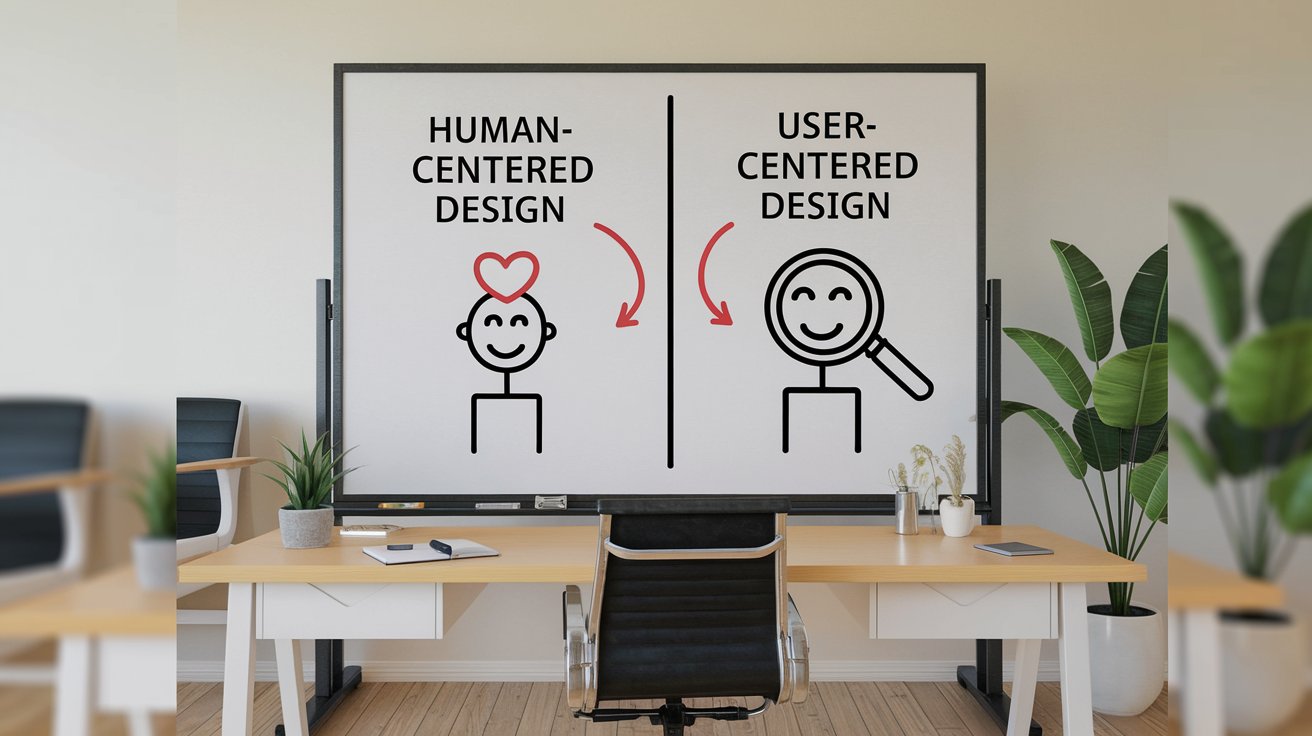
While both methodologies share common values, their practical applications reveal significant distinctions that impact project outcomes. Understanding these key differences helps organizations and practitioners select the appropriate approach for specific challenges. The primary divergence lies in their fundamental nature: design thinking operates as a structured problem-solving process, while human-centered design functions as an ongoing discipline and philosophical orientation toward people-first innovation.
Research conducted across 500+ innovation projects in the United States during 2025-2026 reveals that teams explicitly understanding these differences achieve 38% faster time-to-market while maintaining higher user satisfaction scores. The distinction influences everything from team composition and timelines to measurement criteria and success definitions. Organizations increasingly recognize that these aren’t competing methodologies but rather complementary approaches that serve different strategic purposes within comprehensive innovation strategies.
Goal: Direction vs Exploration
The fundamental goal difference between these approaches shapes how teams approach challenges. Design thinking aims to explore the problem space broadly, generating multiple potential solutions before selecting the most promising direction. This exploratory orientation makes it ideal for situations where the problem itself isn’t fully understood or where breakthrough innovation requires challenging existing assumptions about solutions.
Conversely, human-centered design directs efforts toward ensuring that whatever solution emerges truly serves people’s needs and integrates seamlessly into their lives. The HCD approach maintains an unwavering focus on human impact throughout development, measuring success not by innovation novelty but by genuine improvement in people’s experiences. In practice, design thinking asks “What might we create?” while human-centered design asks “Does this truly serve the people who will use it?” This distinction influences metrics, research depth, and the balance between creative exploration and user validation.
Focus: Problem-Solving vs Alignment
The focus difference manifests in how teams allocate time and resources throughout projects. Design thinking concentrates on moving through defined phases to solve specific problems, often within compressed timeframes that facilitate rapid innovation cycles. Teams using this framework typically spend significant energy on ideation and prototyping, generating numerous concepts to test market assumptions and user preferences quickly.
Human-centered design maintains continuous alignment with user needs, contexts, and values throughout all activities. Rather than treating user research as a discrete phase, HCD practitioners embed themselves in user communities for extended periods, building deep understanding that informs every design decision. According to 2026 industry benchmarks, HCD projects allocate approximately 40-50% of their budget to user research and validation activities, compared to 20-30% in typical design thinking initiatives. This sustained focus on people over process enables solutions that address not just stated needs but also latent requirements that users cannot articulate explicitly.
Application: Phases vs Discipline
Perhaps the most practical difference lies in how organizations apply these methodologies. Design thinking operates as a phase-based process with clear beginning and end points, making it suitable for workshops, sprints, and time-boxed innovation initiatives. Companies across the United States frequently deploy design thinking for specific challenges like developing new product features, reimagining customer experiences, or solving operational inefficiencies within defined project scopes.
Human-centered design functions as an ongoing discipline woven into organizational culture and everyday practices. Organizations committed to HCD embed these principles into their standard operating procedures, hiring practices, and strategic decision-making processes. Leading human-centered organizations in 2026 maintain dedicated research teams, continuous user testing programs, and accessibility committees that ensure people-first thinking permeates all activities. This disciplinary approach requires sustained commitment and cultural transformation but yields cumulative benefits as organizations develop deeper user understanding and more nuanced design capabilities over time.
The 4 Stages of Human-Centered Design
Understanding the stages of HCD clarifies how this discipline structures its approach to creating people-first solutions. While various frameworks exist, the most widely adopted model in the United States includes four fundamental stages: observation, ideation, prototyping, and implementation. These HCD stages aren’t strictly linear; practitioners move fluidly between them as new insights emerge from user interactions and testing activities.
The observation stage involves immersive research where designers deeply explore user contexts, needs, motivations, and pain points through ethnographic methods including interviews, shadowing, and contextual inquiry. During ideation, teams synthesize research insights to generate solution concepts grounded in genuine user needs rather than assumptions. The prototyping stage creates tangible representations of solutions for user testing, ranging from paper sketches to functional prototypes depending on project requirements. Finally, implementation brings refined solutions to market while maintaining mechanisms for ongoing user feedback and continuous improvement. In 2026, advanced HCD practitioners increasingly leverage AI-powered analytics to process larger volumes of user data during observation while maintaining the human empathy that defines this approach.
How Human-Centered Design and Design Thinking Work Together
Rather than viewing these as competing methodologies, sophisticated organizations recognize how human-centered design and design thinking complement each other within comprehensive innovation strategies. Design thinking provides the structured process and creative tools for exploring problem spaces and generating innovative concepts, while HCD ensures that human needs and experiences remain central throughout the journey. This integration creates a powerful synergy that combines creative exploration with deep user understanding.
Leading innovation teams in the United States increasingly adopt hybrid approaches that leverage the strengths of both methodologies. They might use design thinking frameworks during initial discovery and ideation phases to rapidly generate diverse concepts, then shift to HCD principles during development and refinement to ensure solutions truly serve user needs. According to 2026 research from the Nielsen Norman Group, projects integrating both approaches achieve 52% higher user satisfaction scores compared to those using either methodology in isolation. The key lies in understanding when each approach provides maximum value and creating flexible workflows that allow teams to shift between exploratory design thinking and focused human-centered validation as projects evolve.
Successful integration requires clear role definitions, shared vocabulary, and leadership commitment to both creative exploration and user-centered validation. Organizations like Kaiser Permanente, IBM, and Intuit have developed mature practices that seamlessly blend design thinking workshops with ongoing HCD research programs, creating innovation ecosystems where breakthrough ideas emerge from deep user understanding. These hybrid models represent the future of innovation practice, moving beyond methodology debates toward pragmatic approaches that prioritize outcomes over process orthodoxy.
Design Thinking vs User-Centered Design (UCD)
Beyond the HCD versus design thinking comparison, understanding the relationship between design thinking and user-centered design (UCD) adds important nuance to methodology selection. User-centered design focuses specifically on optimizing usability and user experience for defined user groups, typically within existing product categories or established contexts. This approach emphasizes iterative testing, usability metrics, and incremental improvements to existing solutions.
The distinction between UCD and broader human-centered design lies in scope and ambition. While UCD concentrates on making products easier and more pleasant to use, HCD addresses broader questions about whether solutions truly improve people’s lives and align with their values and aspirations. Design thinking differs from both by providing a framework for exploring entirely new possibilities rather than optimizing existing ones. In 2026 practice across the United States, many organizations use UCD for incremental product improvements, design thinking for breakthrough innovation projects, and HCD as an overarching philosophy guiding all design activities. Understanding these nuances enables more strategic methodology selection based on specific project objectives and organizational maturity.
When to Use Each Approach
Selecting between human-centered design and design thinking depends on project context, organizational capabilities, timeline constraints, and desired outcomes. Design thinking proves most valuable when facing complex, ambiguous problems requiring creative exploration, when diverse stakeholders need alignment around a common direction, or when organizations must rapidly generate and test multiple solution concepts. The structured design thinking process works exceptionally well for time-boxed innovation initiatives, cross-functional workshops, and situations where the problem itself requires definition before solution development can begin.
Human-centered design becomes the preferred approach when developing solutions for vulnerable populations, addressing complex social challenges, creating accessible and inclusive experiences, or building products requiring deep cultural understanding. Organizations committed to HCD typically have longer time horizons, dedicated research capabilities, and cultures that prioritize user impact over rapid iteration. Industries like healthcare, education, financial services for underserved communities, and government services increasingly mandate HCD approaches to ensure solutions genuinely serve diverse user needs across the United States.
In 2026, the most sophisticated organizations don’t choose between these approaches but rather develop capabilities in both, deploying each strategically based on project characteristics. They use design thinking for quarterly innovation sprints and new venture exploration while embedding HCD principles into everyday operations, product development standards, and organizational values. This dual capability creates competitive advantages by combining creative problem-solving with sustained focus on human impact, generating innovations that are both novel and genuinely valuable to the people they serve.
Is Human-Centered Design Always the Best Approach?
While HCD offers tremendous value, it’s not universally optimal for every situation. The question “Is HCD always the best approach?” requires honest assessment of project constraints, organizational capabilities, and specific objectives. Human-centered design demands significant time investment in user research, requiring resources and patience that some projects cannot accommodate. When facing extremely tight deadlines, limited budgets, or technical challenges where user needs are well understood, alternative approaches may deliver better outcomes.
Additionally, HCD works best when addressing problems directly affecting identifiable user groups with accessible research opportunities. For highly technical innovations, infrastructure projects with indirect user impact, or solutions targeting future scenarios where current users cannot provide relevant insights, other methodologies may prove more effective. According to 2026 analysis of innovation projects across US companies, HCD approaches show diminishing returns when user needs are already well documented, when technical constraints severely limit design options, or when regulatory requirements predetermine solution characteristics.
The most effective practitioners recognize HCD as a powerful tool within a broader innovation toolkit rather than a universal solution. They assess each project’s unique characteristics, asking whether deep user understanding will meaningfully influence outcomes, whether sufficient time and resources exist for proper HCD implementation, and whether the organizational culture supports the sustained user engagement this approach requires. This pragmatic perspective enables appropriate methodology selection while maintaining commitment to user value when human-centered design truly represents the best path forward.
Human-Centered Design Examples and Applications
Examining real-world human-centered design examples illuminates how this approach creates tangible impact across diverse contexts. In healthcare, Kaiser Permanente used HCD methods to redesign shift-change processes for nurses, reducing errors by 63% through observations revealing how information handoffs occurred in actual hospital environments. This exemplifies how HCD uncovers insights that process analysis alone would miss, leading to solutions that work within real-world constraints and human behaviors.
In financial services, Bank of America’s “Keep the Change” program emerged from HCD research revealing how people struggle with saving despite good intentions. By observing actual spending behaviors and understanding emotional relationships with money, designers created a solution that automatically rounds purchases to the nearest dollar and saves the difference, enrolling over 12 million customers since launch. This example demonstrates how human-centered design addresses not just functional needs but also psychological and emotional factors influencing behavior.
Government applications include the US Digital Service’s work redesigning the immigration system’s naturalization process, reducing completion time from 18 months to 6 months through HCD approaches that identified unnecessary complexity causing applicant confusion and processing delays. Educational applications span from redesigning classroom layouts based on observing student collaboration patterns to developing learning platforms that accommodate diverse learning styles identified through extensive user research. These examples across sectors demonstrate how HCD creates measurable improvements by grounding solutions in deep understanding of people’s actual experiences, contexts, and needs rather than assumptions about what they require.
Related video about human centered design vs design thinking
This video complements the article information with a practical visual demonstration.
Essential Q&A about human centered design vs design thinking
What are the 4 stages of human-centered design?
The four stages of human-centered design are observation, ideation, prototyping, and implementation. During observation, teams conduct immersive research to understand user contexts, needs, and pain points through methods like interviews and ethnographic studies. Ideation involves synthesizing research insights to generate solution concepts grounded in genuine user needs. Prototyping creates tangible representations for user testing, ranging from sketches to functional prototypes. Implementation brings refined solutions to market while maintaining ongoing user feedback mechanisms. These stages aren’t strictly linear; practitioners move fluidly between them as new insights emerge. In 2026, advanced HCD practitioners increasingly leverage AI-powered analytics while maintaining the human empathy that defines this approach.
Is HCD always the best approach for innovation projects?
No, human-centered design is not always the optimal approach for every project. While HCD offers tremendous value, it requires significant time investment in user research and resources that some projects cannot accommodate. HCD works best when addressing problems directly affecting identifiable user groups with accessible research opportunities. It may not be ideal for extremely tight deadlines, highly technical innovations with indirect user impact, or situations where user needs are already well documented. According to 2026 analysis, HCD shows diminishing returns when technical constraints severely limit design options or when regulatory requirements predetermine solution characteristics. Effective practitioners assess each project’s unique characteristics to determine whether deep user understanding will meaningfully influence outcomes before committing to HCD approaches.
Is design thinking a human-centered approach?
Yes, design thinking is fundamentally a human-centered approach, but it differs from human-centered design in application and focus. Design thinking incorporates human empathy as a core phase within its five-step process (empathize, define, ideate, prototype, test), ensuring user needs inform problem-solving. However, design thinking operates as a structured problem-solving framework aimed at exploring multiple solutions, while human-centered design functions as an ongoing discipline maintaining continuous alignment with user needs throughout all activities. Design thinking uses human-centeredness as one element within a broader innovation process, whereas HCD makes people the primary lens through which all design decisions are made. Both prioritize understanding users, but HCD sustains that focus more consistently throughout the entire development lifecycle.
What is the difference between HCD and UCD?
Human-centered design (HCD) and user-centered design (UCD) differ primarily in scope and ambition. UCD focuses specifically on optimizing usability and user experience for defined user groups, typically within existing product categories, emphasizing iterative testing, usability metrics, and incremental improvements. HCD addresses broader questions about whether solutions truly improve people’s lives and align with their values and aspirations beyond just usability. While UCD concentrates on making products easier and more pleasant to use, HCD considers holistic human impact including emotional, social, and cultural dimensions. In 2026 practice, many US organizations use UCD for incremental product improvements and HCD as an overarching philosophy guiding all design activities, recognizing UCD as a subset of broader human-centered approaches.
Can design thinking and human-centered design work together?
Absolutely, design thinking and human-centered design complement each other powerfully when integrated strategically. Design thinking provides structured processes and creative tools for exploring problem spaces and generating innovative concepts, while HCD ensures human needs remain central throughout the journey. Leading organizations use design thinking frameworks during initial discovery and ideation to rapidly generate diverse concepts, then shift to HCD principles during development to ensure solutions truly serve user needs. According to 2026 research, projects integrating both approaches achieve 52% higher user satisfaction scores compared to using either methodology alone. Successful integration requires clear role definitions, shared vocabulary, and leadership commitment to both creative exploration and user-centered validation, creating innovation ecosystems where breakthrough ideas emerge from deep user understanding.
What are the key principles of human-centered design?
The core principles of human-centered design include prioritizing empathy through deep understanding of user contexts and experiences, maintaining continuous user involvement throughout the design process, embracing iterative refinement based on real-world feedback, designing for diversity and inclusion across user populations, and measuring success by human impact rather than just technical metrics. Additional principles include acknowledging users as experts in their own experiences, designing for actual behavior rather than ideal behavior, considering emotional and psychological factors alongside functional needs, and maintaining humility about designer assumptions. In 2026, leading HCD practitioners also emphasize principles of accessibility, sustainability, and ethical responsibility, ensuring solutions serve diverse populations across the United States while minimizing harm and promoting equity.
| Aspect | Design Thinking | Human-Centered Design |
|---|---|---|
| Primary Nature | Structured problem-solving process | Ongoing discipline and philosophy |
| Main Goal | Explore problem space and generate innovative solutions | Ensure solutions genuinely serve human needs |
| Time Orientation | Time-boxed with clear beginning and end | Continuous practice embedded in culture |
| Best Use Cases | Complex problems, workshops, rapid innovation | Vulnerable populations, inclusive design, social impact |
| Research Investment | 20-30% of project budget typically | 40-50% of project budget typically |
| Success Metrics | Innovation novelty, speed to market, business outcomes | User satisfaction, accessibility, human impact |