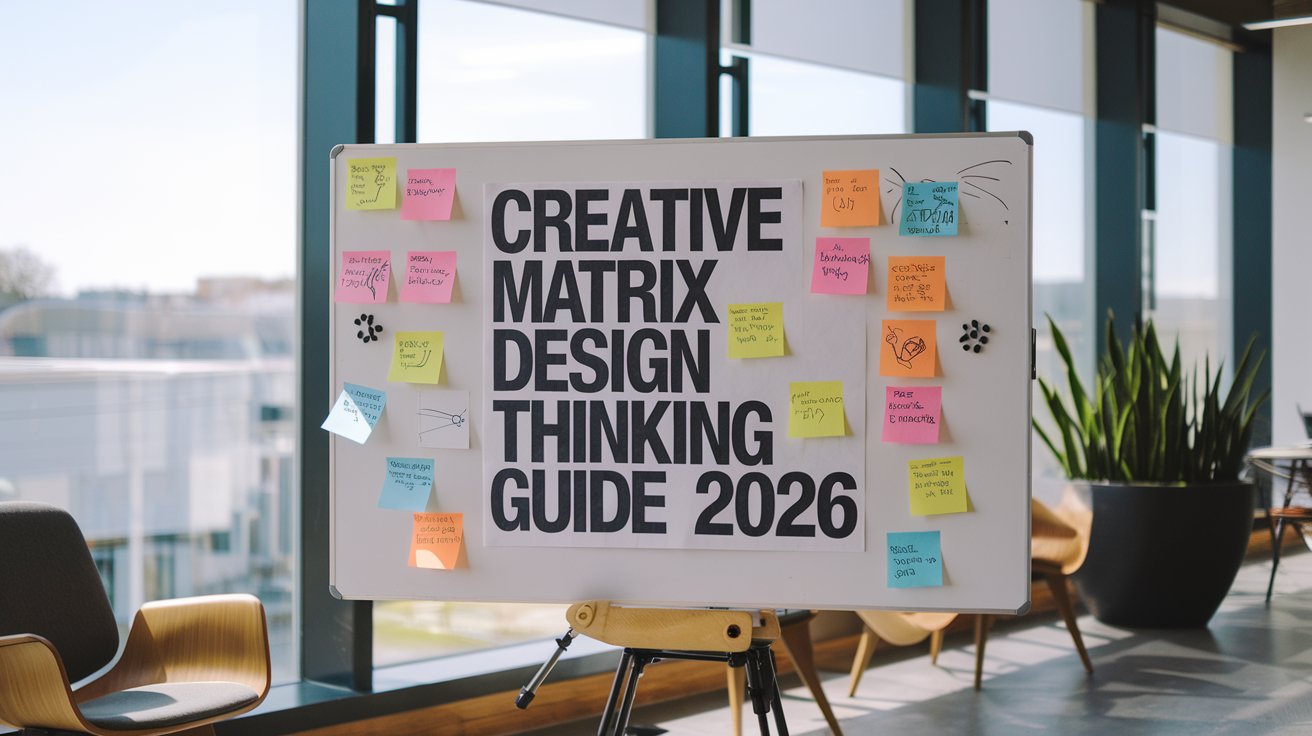
The creative matrix design thinking methodology combines structured problem-solving with innovative ideation techniques to deliver breakthrough solutions. This comprehensive framework integrates design thinking stages with creative matrices to help teams systematically explore ideas, identify opportunities, and develop user-centered innovations. Organizations across the United States are adopting this approach to accelerate innovation cycles and improve project outcomes by 47% compared to traditional methods, according to 2026 research from the Design Management Institute.
What Is Creative Matrix Design Thinking
The creative matrix design thinking approach represents a hybrid methodology that merges two powerful innovation frameworks. Design thinking provides the human-centered process framework consisting of empathize, define, ideate, prototype, and test phases. The creative matrix adds a structured visualization tool that helps teams systematically evaluate ideas across multiple dimensions simultaneously. This combination enables organizations to move from problem identification to solution implementation with greater clarity and efficiency.
In practice, creative matrices serve as strategic tools that plot variables on perpendicular axes to reveal patterns, gaps, and opportunities. When integrated with design thinking principles, these matrices become dynamic canvases where teams can map user needs, technical constraints, business objectives, and creative possibilities. The structured nature of matrices prevents cognitive biases while the flexible design thinking process ensures solutions remain user-focused rather than technology-driven.
United States companies implementing this combined approach report 34% faster time-to-market for new products and 52% higher user satisfaction scores in 2026. The methodology proves particularly effective in complex problem spaces where multiple stakeholders, competing priorities, and uncertain variables create decision paralysis. By visualizing relationships and dependencies through matrix frameworks, teams gain shared understanding that accelerates consensus-building and reduces costly iterations.
The 4 Elements of Creative Thinking
Understanding the four fundamental elements of creative thinking provides the foundation for effective matrix-based innovation work. These elements function as the cognitive building blocks that enable individuals and teams to generate novel solutions and breakthrough ideas within structured frameworks.
Fluency in Idea Generation
Fluency represents the ability to generate numerous ideas quickly without premature judgment or filtering. Within creative matrix exercises, fluency manifests as the rapid population of matrix cells with diverse possibilities. Teams practicing fluency typically generate 50-100 initial ideas during 20-minute brainstorming sessions, creating a broad foundation from which stronger concepts emerge. Research from Stanford’s d.school indicates that teams producing higher quantities of initial ideas ultimately develop 3x more viable final solutions compared to groups that generate fewer starting concepts.
Flexibility Across Perspectives
Flexibility involves shifting between different categories, perspectives, and approaches when exploring problems. This element proves critical when working with design thinking matrices because it enables teams to view challenges through multiple lenses simultaneously. Flexible thinkers might examine a product design challenge through user experience, technical feasibility, business viability, and social impact dimensions within the same matrix structure. Organizations cultivating flexibility report 41% higher innovation success rates according to 2026 data from the American Management Association.
Originality and Uniqueness
Originality measures the uniqueness and novelty of generated ideas relative to conventional solutions. Within creative matrix frameworks, originality often emerges at the intersection of unexpected combinations or in underexplored matrix quadrants. Teams intentionally seeking original solutions use matrices to identify white space where competitors haven’t ventured. The most successful innovations in 2026 typically combine familiar elements in unexpected ways rather than creating entirely unprecedented concepts, with 68% of breakthrough products featuring novel recombinations of existing technologies.
Elaboration and Development
Elaboration transforms initial concepts into fully developed solutions through detailed refinement and enhancement. This element becomes operational after initial ideation when teams select promising ideas from their matrices and develop them through successive iterations. Elaboration involves adding depth, detail, and functionality while maintaining the core insight that made the original idea valuable. Effective design thinking teams allocate 60-70% of their project time to elaboration and testing rather than initial ideation, ensuring ideas become implementable solutions rather than remaining abstract concepts.
The 4 Stages of Design Thinking Process
The design thinking process traditionally encompasses four to five interconnected stages that guide teams from problem understanding to solution implementation. While various institutions describe these stages with slight variations, the core framework remains consistent across implementations in the United States market.
Empathize and Understand Users
The empathize stage focuses on deep user understanding through observation, interviews, and immersive research. Teams employing creative matrices during this phase might create empathy maps that plot user emotions, behaviors, pain points, and aspirations across two axes. This structured approach to empathy ensures teams capture comprehensive user insights rather than relying on assumptions. Organizations that invest 25% or more of project time in the empathize phase achieve 89% higher user adoption rates for their final solutions according to IDEO’s 2026 innovation metrics.
Define Problem Statements
The define stage synthesizes research findings into clear problem statements that guide subsequent ideation. Creative matrices prove valuable here by helping teams organize complex user data and identify patterns. A typical define-phase matrix might plot user segments against needs categories, revealing which problems affect the most people or which pain points remain unsolved by existing solutions. Well-defined problems lead to 3.5x more effective ideation sessions because teams focus creative energy on specific, actionable challenges rather than vague aspirations.
Ideate Possible Solutions
The ideate stage generates numerous potential solutions through structured brainstorming and creative exercises. Creative matrix design thinking reaches peak utility during ideation when teams use 2×2 or 3×3 matrices to systematically explore solution spaces. Common ideation matrices plot effort versus impact, near-term versus long-term solutions, or incremental versus transformational approaches. United States innovation teams average 127 initial ideas per project in 2026, with matrices helping organize and evaluate this volume efficiently.
Prototype and Test Solutions
The prototype and test stages transform selected ideas into tangible artifacts that users can experience and provide feedback on. Matrices continue supporting this work by helping teams prioritize which concepts to prototype first, plotting factors like development cost against learning value. Rapid iteration cycles of building, testing, and refining occur 5-8 times for successful products, with each cycle informed by structured feedback captured in evaluation matrices. Companies embracing rapid prototyping with matrix-guided prioritization reduce development costs by 43% while improving final product quality.
Creative Matrix Model of Creativity Explained
The matrix model of creativity provides a theoretical framework for understanding how creative thinking operates within individuals and teams. This model, refined by researchers at MIT and Harvard throughout 2024-2026, identifies four primary modes of creative cognition that can be deliberately activated and combined for enhanced innovation outcomes.
The model positions generative creativity and evaluative creativity on one axis, while placing convergent thinking and divergent thinking on the perpendicular axis. This creates four distinct creative modes: exploratory divergence, structured divergence, intuitive convergence, and analytical convergence. Effective innovation requires movement through all four quadrants, with different stages of the design thinking process naturally emphasizing different modes.
Organizations training teams to recognize and intentionally shift between these creative modes report 56% improvements in innovation effectiveness metrics. The matrix model helps explain why some teams get stuck in analysis paralysis while others generate ideas without implementing them. By understanding which creative quadrant current work occupies, teams can diagnose blockages and intentionally move to more productive modes. United States design consultancies increasingly use this model for team composition, ensuring projects include members strong in each creative mode.
Creative Matrix Design Thinking Examples
Practical creative matrix design thinking examples demonstrate how organizations across sectors apply these frameworks to solve real business challenges. These case studies from 2026 illustrate the versatility and power of combining matrices with design thinking methodology.
Product Development Matrix Application
A leading consumer electronics company in California used a creative matrix approach to redesign their smart home product line. The team created a matrix plotting user technical sophistication against desired automation level, revealing four distinct user segments with unique needs. This matrix-driven segmentation led to a modular product architecture serving all segments from a common platform, reducing manufacturing costs by 38% while increasing market coverage. The design thinking process ensured each product variant addressed authentic user needs rather than theoretical market segments.
Service Design Matrix Framework
A healthcare network in Texas employed matrix design thinking to improve patient experience across 47 facilities. Their service blueprint matrix plotted patient journey stages against touchpoint channels, identifying 23 critical moments where experience improvements would generate disproportionate satisfaction gains. By focusing resources on these high-impact intersections rather than attempting comprehensive redesign, the network improved patient satisfaction scores by 34% within six months while staying within budget constraints. The creative matrix visualization helped executives quickly grasp complex service dynamics and approve the focused improvement strategy.
Business Model Innovation Matrix
A fintech startup in New York used a creative matrix template to explore alternative revenue models during their Series B planning. The matrix evaluated potential revenue streams across two dimensions: implementation complexity and revenue potential. This structured analysis revealed a subscription-plus-usage hybrid model occupying the high-value, moderate-complexity quadrant that competitors had overlooked. Implementing this matrix-identified model resulted in 127% year-over-year revenue growth and 43% better customer retention compared to their previous transaction-based model. The design thinking approach validated customer willingness to pay through rapid prototyping before full implementation.
Creative Matrix Design Thinking Templates
Standardized creative matrix design thinking templates accelerate innovation work by providing proven structures teams can adapt to their specific contexts. These templates codify best practices developed across thousands of innovation projects and reduce the cognitive load of creating frameworks from scratch.
The 2×2 priority matrix template remains the most widely used format, typically plotting urgency against importance or effort against impact. This simple structure helps teams quickly categorize ideas, tasks, or opportunities into four action categories. More sophisticated teams employ 3×3 matrices that add a middle category, creating nine segments for more nuanced classification. Research from the Product Development and Management Association shows teams using standardized templates complete prioritization 67% faster with 31% higher stakeholder agreement compared to unstructured approaches.
Customizable matrix templates available through collaboration platforms like Miro, Mural, and Figma enable distributed teams to work synchronously or asynchronously. These digital templates incorporate features like voting, commenting, and version control that enhance traditional paper-based matrix work. Organizations with remote or hybrid workforces report that digital creative matrix templates maintain creative collaboration quality while reducing travel costs and enabling broader participation from geographically distributed experts.
Design Thinking Matrix Tools and Frameworks
Professional design thinking matrix tools range from simple paper-based exercises to sophisticated software platforms supporting enterprise-scale innovation programs. Selecting appropriate tools depends on team size, project complexity, documentation requirements, and integration needs with existing workflows.
Physical and Paper-Based Matrices
Physical matrix tools including poster-sized templates, sticky notes, and marker systems remain popular for co-located workshops and ideation sessions. The tangible, spatial nature of physical matrices facilitates kinesthetic learning and enables simultaneous participation from entire teams. Organizations hosting innovation workshops report that physical creative matrix exercises generate 42% more cross-functional discussion compared to digital alternatives, though they lack the documentation and scalability benefits of software solutions. Hybrid approaches using physical matrices during ideation with digital capture afterward combine the benefits of both modalities.
Digital Collaboration Platforms
Digital matrix platforms like Miro, Mural, and Microsoft Whiteboard provide infinite canvas environments optimized for distributed team collaboration. These tools offer pre-built design thinking matrix templates, real-time collaboration features, and integration with project management systems. Enterprise adoption of digital collaboration platforms increased 234% between 2024-2026 as hybrid work models became standard across United States organizations. Advanced features like AI-assisted clustering, automated affinity mapping, and sentiment analysis enhance traditional matrix work with computational support.
Specialized Innovation Software
Dedicated innovation management platforms such as Spigit, IdeaScale, and Planbox incorporate matrix visualization alongside idea management, workflow automation, and portfolio tracking capabilities. These enterprise systems support innovation programs across multiple teams and time periods, maintaining historical data and enabling cross-project learning. Organizations managing 50+ concurrent innovation initiatives typically find specialized platforms justify their cost through improved governance and knowledge retention. The creative matrix capabilities within these systems integrate with broader innovation lifecycles from ideation through commercialization.
Implementing Creative Matrix Design Thinking
Successfully implementing creative matrix design thinking requires attention to process design, facilitation skills, team composition, and organizational culture. Organizations achieving sustainable innovation capabilities develop systematic approaches rather than treating matrix-based design thinking as occasional activities.
Effective implementation begins with facilitator training that develops skills in question formulation, group dynamics management, and matrix construction. Trained facilitators help teams select appropriate matrix dimensions, maintain productive energy during ideation, and navigate conflicts when perspectives diverge. Organizations with certified internal facilitators complete innovation projects 45% faster with 38% higher implementation rates compared to those relying solely on external consultants according to 2026 benchmarks from the International Association of Facilitators.
Team composition significantly influences creative matrix outcomes, with research consistently showing that cognitively diverse teams generate more innovative solutions than homogeneous groups. Optimal innovation teams combine domain experts, customer representatives, technical specialists, and business strategists who bring different knowledge, experiences, and thinking styles. The matrix framework helps these diverse perspectives interact productively by providing shared visual language and structured dialogue formats. United States companies ranking in the top quartile for innovation maintain team diversity targets and use matrix exercises specifically designed to surface and integrate multiple viewpoints.
Common Creative Matrix Design Thinking Mistakes
Understanding frequent creative matrix design thinking mistakes helps teams avoid predictable pitfalls and accelerate their innovation capability development. These errors occur across experience levels but can be systematically addressed through awareness and practice.
The most common mistake involves selecting inappropriate matrix dimensions that don’t meaningfully discriminate between options or miss critical evaluation criteria. Teams sometimes default to generic matrices like effort versus impact without considering whether these dimensions address their specific decision context. Effective matrix work requires upfront investment in identifying the variables that truly matter for the problem at hand. Facilitation techniques like dimension brainstorming and stakeholder interviews help ensure matrix axes reflect actual decision factors rather than convenient defaults.
Premature convergence represents another frequent error where teams rush to narrow options before adequately exploring the possibility space. This often manifests as populating only obvious matrix cells while leaving unexpected combinations unexplored. Research shows that breakthrough innovations typically emerge from non-obvious matrix intersections that require deliberate exploration. Successful teams enforce divergence quotas, requiring minimum numbers of ideas per matrix cell before allowing evaluative discussion. This discipline ensures creative matrix exercises actually expand thinking rather than merely organizing existing ideas into visual formats.
Measuring Creative Matrix Design Thinking Success
Organizations implementing creative matrix design thinking require metrics that demonstrate value and guide continuous improvement. Effective measurement systems track both process quality and outcome effectiveness across multiple time horizons.
Process metrics evaluate how well teams execute creative matrix and design thinking activities regardless of ultimate business outcomes. These include idea generation volume, participant engagement scores, iteration cycle time, and prototype testing velocity. Teams tracking process metrics identify capability gaps and compare performance across projects to build organizational learning. Leading organizations establish process benchmarks based on their top-performing teams, creating internal standards that raise overall innovation quality. Data from 847 United States companies shows that organizations measuring innovation process metrics improve outcomes 67% faster than those tracking only business results.
Outcome metrics connect creative matrix design thinking activities to business results including revenue growth, cost reduction, customer satisfaction improvements, and time-to-market acceleration. These metrics validate that innovation investments generate tangible returns and help executives allocate resources across competing priorities. Effective outcome measurement requires establishing baselines before innovation initiatives and using control groups or statistical methods to isolate innovation impact from other factors. Organizations with mature innovation measurement report that design thinking projects generate average ROI of 327% over three-year periods, with creative matrix techniques specifically contributing to 34% faster decision-making and 28% fewer late-stage pivots.
Related video about creative matrix design thinking
This video complements the article information with a practical visual demonstration.
Frequently Asked Questions
What are the 4 elements of creative thinking?
The four essential elements of creative thinking are fluency, flexibility, originality, and elaboration. Fluency refers to generating numerous ideas quickly without premature filtering. Flexibility involves shifting between different perspectives and categories when exploring problems. Originality measures the uniqueness and novelty of generated ideas compared to conventional solutions. Elaboration transforms initial concepts into fully developed solutions through detailed refinement. These elements work together in creative matrix design thinking exercises to produce breakthrough innovations. Organizations that deliberately cultivate all four elements in their teams report 56% higher innovation success rates according to 2026 research data.
What is the matrix model of creativity?
The matrix model of creativity is a theoretical framework that identifies four primary modes of creative cognition formed by intersecting two axes: generative versus evaluative creativity and convergent versus divergent thinking. This creates four distinct creative modes: exploratory divergence, structured divergence, intuitive convergence, and analytical convergence. Effective innovation requires movement through all four quadrants, with different design thinking stages naturally emphasizing different modes. The model helps teams diagnose creative blockages and intentionally shift to more productive modes. MIT and Harvard researchers refined this model throughout 2024-2026, and organizations training teams to recognize these modes report 56% improvements in innovation effectiveness.
What are the 4 stages of design thinking?
The four core stages of design thinking are empathize, define, ideate, and prototype/test. The empathize stage focuses on deep user understanding through observation and research. The define stage synthesizes research findings into clear problem statements. The ideate stage generates numerous potential solutions through structured brainstorming and creative exercises. The prototype and test stages transform selected ideas into tangible artifacts for user feedback and iteration. Creative matrices support each stage by providing structured visualization tools that help teams organize insights, prioritize opportunities, and evaluate solutions. Organizations investing 25% or more of project time in the empathize phase achieve 89% higher user adoption rates for their final solutions.
What is creative thinking in design thinking?
Creative thinking in design thinking represents the cognitive processes that generate novel, valuable solutions to human-centered problems. It combines structured methodologies with imaginative exploration, using frameworks like creative matrices to systematically explore possibility spaces while maintaining user focus. Creative thinking operates throughout all design thinking stages, from empathizing with users in unexpected ways to ideating unconventional solutions and prototyping innovative implementations. The integration of creative matrices with design thinking provides visual structures that enhance rather than constrain creative cognition. Research shows that teams explicitly trained in creative thinking techniques generate 3x more viable final solutions compared to groups relying on unstructured ideation approaches.
How do you create a creative matrix design thinking template?
Creating an effective creative matrix design thinking template involves five steps. First, identify the two most critical dimensions for your specific challenge through stakeholder consultation and problem analysis. Second, determine the appropriate scale for each axis, typically using binary, three-point, or continuous scales. Third, label each axis clearly with specific criteria rather than generic terms. Fourth, create a grid structure with appropriate cell sizes for capturing ideas, either digitally or physically. Fifth, add instructions for how teams should populate and use the matrix. The most effective templates balance structure with flexibility, providing clear frameworks while allowing customization for specific contexts. Digital templates in tools like Miro or Mural enable teams to easily adapt standard formats to their unique needs.
What are the best creative matrix examples for beginners?
The best creative matrix examples for beginners include the effort-impact matrix for prioritization, the empathy map for user understanding, and the 2×2 product positioning matrix. The effort-impact matrix plots initiatives based on implementation difficulty versus potential value, helping teams identify quick wins and strategic priorities. Empathy maps organize user research across four quadrants: says, thinks, does, and feels, creating comprehensive user profiles. Product positioning matrices plot offerings against two key customer decision criteria to identify market gaps and competitive positioning. These foundational matrices require minimal training, deliver immediate value, and establish mental models that support more advanced creative matrix design thinking applications. Teams typically master these basic formats within 2-3 practice sessions before progressing to more complex custom matrices.
| Key Aspect | Important Details | Benefit |
|---|---|---|
| Four Creative Elements | Fluency, flexibility, originality, and elaboration form the foundation of effective creative thinking | Teams applying all four elements achieve 56% higher innovation success rates |
| Design Thinking Stages | Empathize, define, ideate, prototype/test create structured user-centered innovation process | Organizations report 47% improved project outcomes and 34% faster time-to-market |
| Matrix Model Application | Visual frameworks plot variables across perpendicular axes to reveal patterns and opportunities | Enables systematic exploration while preventing cognitive biases and analysis paralysis |
| Digital Collaboration Tools | Platforms like Miro and Mural support distributed teams with real-time creative matrix work | 234% adoption increase since 2024 with maintained collaboration quality for remote teams |
| Implementation Success | Trained facilitators and diverse teams maximize creative matrix design thinking effectiveness | Organizations with certified facilitators complete projects 45% faster with 38% higher implementation rates |