
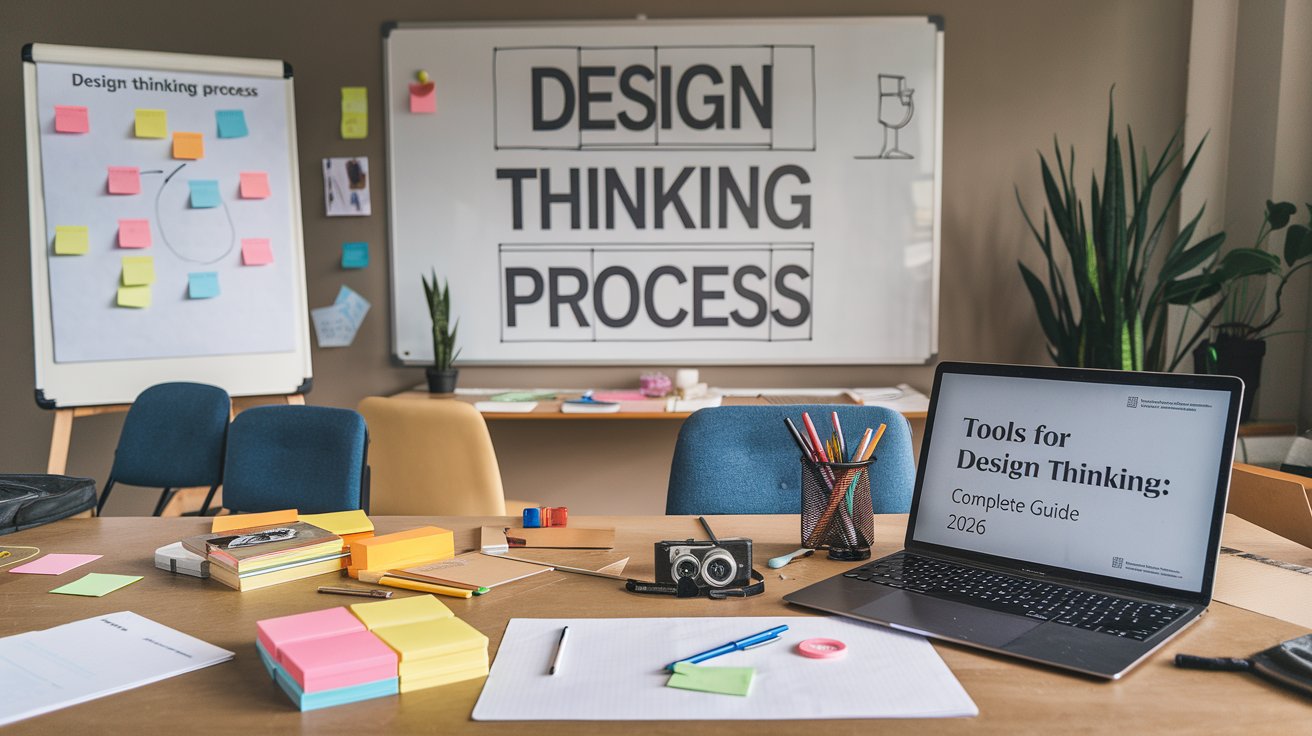
Design thinking has evolved into a critical methodology for innovation across industries in the United States, with tools for design thinking becoming essential for teams seeking user-centered solutions. As organizations navigate increasingly complex challenges in 2026, selecting the right combination of digital platforms, physical materials, and collaborative frameworks can dramatically accelerate the journey from empathy to implementation. This comprehensive guide explores proven tools, methods, and techniques that empower teams to ideate, prototype, and test solutions effectively while maintaining focus on human needs.
Understanding Design Thinking and Its Essential Tools
Design thinking represents a human-centered approach to innovation that combines creative problem-solving with systematic methodology. In 2026, approximately 78% of Fortune 500 companies in the United States have integrated design thinking into their innovation processes, recognizing its power to generate breakthrough solutions. The framework relies on iterative cycles of understanding users, challenging assumptions, redefining problems, and creating innovative solutions through prototyping and testing.
The effectiveness of design thinking tools lies in their ability to facilitate collaboration, capture insights, and translate abstract concepts into tangible outcomes. These tools range from simple sticky notes and whiteboards to sophisticated digital platforms that enable remote collaboration. Understanding which tools align with each phase of the design thinking process ensures teams can maintain momentum while generating meaningful innovations that resonate with real user needs.
The Five Phases of Design Thinking
The design thinking process consists of five interconnected phases that guide teams from initial research to final implementation. These phases include empathize, define, ideate, prototype, and test, each requiring specific tools and methods to maximize effectiveness. While the process appears linear, successful practitioners move fluidly between phases, returning to earlier stages as new insights emerge throughout the journey.
Empathize Phase Tools and Methods
The empathize stage focuses on understanding users at a profound level through observation, engagement, and immersion in their experiences. Essential tools for this phase include empathy maps, user interview guides, observation frameworks, and journey mapping templates. In 2026, digital ethnography tools have become increasingly sophisticated, allowing teams to gather insights from diverse user populations across the United States through video interviews, remote observation platforms, and AI-assisted sentiment analysis.
Effective empathy tools help teams document behavioral patterns, emotional responses, pain points, and unexpressed needs. Platforms like Miro and MURAL provide virtual spaces where teams can collaborate on empathy mapping exercises, organizing insights into categories such as what users say, think, do, and feel. Physical tools like interview kits with recording equipment, observation checklists, and cultural probes continue to provide valuable depth in face-to-face research scenarios.
Define Phase Tools and Frameworks
The define phase synthesizes research findings into actionable problem statements that guide subsequent ideation efforts. Key tools include point-of-view statements, problem framing templates, How Might We question frameworks, and persona development kits. Teams use affinity diagrams to cluster insights, identifying patterns that reveal underlying user needs rather than surface-level wants. The goal involves crafting a clear, user-centered problem statement that inspires creative solutions.
Modern digital collaboration tools have transformed how teams synthesize research data, with platforms offering AI-powered analysis that identifies themes across hundreds of user interviews. However, the most effective define-phase work still involves human interpretation and discussion, using tools like POV Mad Libs and problem statement worksheets to ensure alignment around the challenge being addressed before moving forward into ideation.
Essential Ideation Tools and Techniques
The ideate phase requires tools for generating diverse ideas without judgment, encouraging quantity over quality initially to explore the full solution space. Brainstorming remains foundational, but has evolved beyond simple group discussions to include structured techniques like SCAMPER, Crazy 8s, brainwriting, and reverse thinking exercises. In 2026, hybrid ideation combining in-person and virtual participants has become standard practice across United States organizations.
Digital ideation platforms such as Stormboard, IdeaFlip, and integrated design thinking toolboxes provide structured environments where teams can generate, organize, and build upon ideas collaboratively. These platforms typically include voting mechanisms, categorization features, and integration with prototyping tools to accelerate movement from concept to tangible representation. Physical ideation tools like whiteboards, sticky notes in multiple colors, and dot voting stickers remain valuable for their tactile engagement and visual impact.
Brainstorming Methods and Variations
Traditional brainstorming has spawned numerous variations optimized for different team dynamics and challenges. Brainwriting techniques like 6-3-5 method enable quieter team members to contribute equally, while round-robin approaches ensure every voice is heard systematically. Reverse brainstorming asks teams to generate ideas for making the problem worse, then inverting those ideas to discover novel solutions that might not emerge through conventional positive thinking.
The Crazy 8s technique pushes rapid ideation by requiring participants to sketch eight distinct ideas in eight minutes, preventing overthinking and encouraging exploration beyond obvious solutions. SCAMPER provides a structured checklist prompting teams to consider substituting, combining, adapting, modifying, putting to other uses, eliminating, or reversing elements of existing solutions to generate fresh perspectives on the challenge.
Digital Ideation Platforms for 2026
The landscape of digital ideation tools has expanded significantly, with platforms now offering AI-assisted suggestion features, real-time collaboration across time zones, and integration with prototyping and project management systems. Miro leads with its infinite canvas approach and extensive template library, while FigJam provides seamless integration with design workflows. Platforms like Conceptboard and Mural excel at facilitating structured workshops with built-in timers, voting mechanisms, and presentation modes.
Emerging tools in 2026 incorporate artificial intelligence to suggest combinations of existing ideas, identify gaps in solution coverage, and even generate initial concept sketches based on textual descriptions. However, human judgment remains essential for evaluating feasibility, desirability, and viability of proposed solutions. The most effective teams use digital platforms to capture and organize ideas while maintaining space for spontaneous, unstructured creative thinking.
Prototyping Tools and Resources
Prototyping transforms abstract ideas into tangible representations that can be tested with users, providing rapid feedback loops that inform iterative refinement. The fidelity of prototypes ranges from rough sketches and paper models to high-fidelity digital mockups and functional prototypes, with tool selection depending on the stage of development and type of solution being created. In 2026, approximately 84% of design teams in the United States use multiple prototyping tools across different fidelity levels.
Low-fidelity prototyping tools include paper, cardboard, foam core, clay, and basic craft supplies that enable quick physical model creation without significant time investment. Digital low-fidelity tools like Balsamiq and Wireframe.cc allow rapid creation of screen layouts and user flows. High-fidelity prototyping employs tools like Figma, Adobe XD, Sketch, and Axure for creating interactive digital prototypes that simulate final product experiences with realistic interactions and visual design.
Physical Prototyping Materials and Methods
Physical prototypes provide tactile feedback that digital representations cannot replicate, making them essential for product design and spatial experience innovation. Basic materials like cardboard, foam board, and hot glue enable rapid three-dimensional model creation, while maker spaces equipped with 3D printers, laser cutters, and CNC machines allow more sophisticated fabrication. The key is selecting materials that match the fidelity needed for the testing stage without overinvesting in polish.
Role-playing and service staging represent powerful prototyping techniques for experience design, allowing teams to walk through service interactions and identify friction points before implementation. Tools like journey maps, service blueprints, and storyboards guide these enactments, while video recording captures details for later analysis. Physical prototyping excels at revealing unexpected usability issues that might be overlooked in purely digital representations.
Digital Prototyping Platforms
Modern digital prototyping tools have converged toward all-in-one platforms that support design, prototyping, collaboration, and handoff to development teams. Figma dominates in 2026 with its browser-based collaborative approach, real-time multiplayer editing, and extensive plugin ecosystem. Adobe XD provides tight integration with Creative Cloud applications, while Sketch remains popular on Mac platforms for its performance with complex design systems.
Specialized prototyping tools serve specific needs, with InVision excelling at creating interactive clickable prototypes from static designs, while Principle and Framer focus on animation and interaction design. No-code platforms like Webflow and Bubble enable creation of functional web prototypes without programming, accelerating testing of complex interactive concepts. The trend toward integrated design systems ensures consistency across prototypes while enabling rapid iteration based on user feedback.
Testing and Validation Tools
The testing phase closes the design thinking loop by gathering user feedback on prototypes, validating assumptions, and identifying refinement opportunities before significant resource investment. Testing tools range from simple observation protocols and interview guides to sophisticated usability testing platforms with eye-tracking, session recording, and quantitative metrics. Effective testing combines qualitative insights about user experience with quantitative data about behavior and performance.
In 2026, remote usability testing tools have become standard, enabling teams to test with diverse user populations across the United States without geographic constraints. Platforms like UserTesting, Maze, and Lookback provide moderated and unmoderated testing options, recording user sessions, capturing verbal feedback, and generating analytics about task completion rates and navigation patterns. A/B testing tools integrate with prototypes to compare alternative designs quantitatively, informing data-driven decisions about which direction to pursue.
Qualitative Testing Methods
Qualitative testing uncovers the why behind user behaviors, providing rich insights that quantitative metrics alone cannot reveal. Think-aloud protocols ask users to verbalize their thoughts while interacting with prototypes, exposing confusion, delight, and unexpected mental models. Observation frameworks help teams systematically capture body language, facial expressions, and interaction patterns that reveal emotional responses to design decisions.
Interview guides structure post-test discussions, probing deeper into user experiences and gathering suggestions for improvement. Tools like rainbow sheets and insight capture templates help teams document and categorize findings during testing sessions, ensuring valuable observations are not lost. The most effective qualitative testing involves multiple team members as observers, bringing diverse perspectives to interpretation of user feedback and identification of priority improvements.
Quantitative Testing Platforms
Quantitative testing provides measurable data about prototype performance, enabling objective comparison of alternatives and tracking improvement across iterations. Analytics platforms embedded in prototypes track click patterns, time on task, error rates, and conversion metrics, revealing where users struggle or succeed. Heat mapping tools visualize attention patterns, showing which elements attract focus and which are overlooked despite their importance.
A/B testing platforms like Optimizely and Google Optimize allow teams to present different prototype versions to user segments, measuring which performs better against defined success metrics. Survey tools like Typeform and SurveyMonkey gather structured user feedback with quantifiable ratings and rankings, complementing qualitative insights with statistical data. The integration of qualitative and quantitative methods provides the most comprehensive understanding of prototype strengths and improvement opportunities.
Collaborative Tools for Design Thinking Teams
Design thinking thrives on collaboration, requiring tools that facilitate communication, coordination, and collective creativity across diverse team members. In 2026, the hybrid work environment has made digital collaboration tools essential, though in-person collaboration remains valuable for certain activities. The most effective teams use a combination of synchronous and asynchronous tools, enabling real-time workshops alongside ongoing contribution and refinement.
Video conferencing platforms like Zoom and Microsoft Teams provide the foundation for remote collaboration, while specialized tools add design thinking-specific functionality. Digital whiteboards such as Miro, MURAL, and Conceptboard replicate the experience of physical whiteboard sessions with sticky notes, drawings, and voting capabilities. Project management platforms like Trello, Asana, and Monday.com help teams track progress through design thinking phases, assigning responsibilities and maintaining momentum between workshop sessions.
Workshop Facilitation Tools
Facilitating effective design thinking workshops requires tools that structure activities, manage time, and maintain participant engagement. Digital timers and agenda management tools keep sessions moving through planned activities without rushing or losing focus. Template libraries provide proven frameworks for common activities like empathy mapping, journey mapping, and assumption testing, reducing preparation time while ensuring quality outcomes.
Polling and voting tools like Mentimeter and Slido gather quick input from all participants, ensuring diverse perspectives inform decision-making. Breakout room functionality in video platforms enables small group work within larger sessions, while shared document editing in Google Workspace or Microsoft 365 allows real-time collaborative writing of problem statements, personas, and other artifacts. The combination of structure and flexibility enables productive workshops that generate meaningful results.
Documentation and Knowledge Management
Capturing and organizing insights throughout the design thinking process ensures learning persists beyond individual projects and informs future initiatives. Documentation tools range from simple shared folders to sophisticated knowledge management systems that tag, search, and surface relevant past work. Confluence and Notion provide wiki-like environments where teams can build living repositories of research findings, design decisions, and testing results.
Visual documentation through photography, video recording, and screenshot tools preserves the richness of workshops and user research sessions. Synthesis tools help teams process large volumes of qualitative data, identifying patterns and themes across multiple research sessions. The discipline of documentation transforms individual project insights into organizational knowledge, building design thinking capability and preventing repeated mistakes or duplicated research efforts.
Industry-Specific Design Thinking Tools
Different industries have developed specialized tools for design thinking that address sector-specific challenges and opportunities. Healthcare organizations use patient journey mapping tools that account for clinical workflows and regulatory requirements, while financial services employ frameworks that balance innovation with risk management and compliance. Educational institutions adapt design thinking tools to engage students as co-creators, using age-appropriate materials and facilitation approaches.
Technology companies in 2026 increasingly integrate design thinking tools directly into development environments, enabling seamless transition from ideation to implementation. Manufacturing organizations use design thinking methods alongside traditional engineering approaches, employing tools that bridge creative exploration and technical feasibility assessment. The adaptation of core design thinking principles to industry contexts ensures relevance while maintaining the human-centered focus that makes the methodology powerful.
Building Your Design Thinking Toolkit
Assembling an effective toolkit requires balancing comprehensiveness with simplicity, avoiding tool overload while ensuring capabilities for each design thinking phase. Start with free or low-cost options to build familiarity before investing in premium platforms. Many organizations in the United States find success with a core set of versatile tools supplemented by specialized options for specific challenges or project types.
A basic toolkit should include collaboration and communication platforms, ideation and brainstorming tools, prototyping capabilities at multiple fidelity levels, and testing and feedback mechanisms. Physical supplies like sticky notes, markers, and poster paper remain valuable even for digitally-focused teams. Tool selection should prioritize ease of use, team adoption, and integration with existing workflows over feature richness that may go unused. Regular toolkit review ensures tools continue serving team needs as projects and capabilities evolve.
Free and Open Source Options
Budget-conscious teams can access powerful design thinking tools without licensing costs through free and open-source options. Miro offers a free tier supporting up to three editable boards, while FigJam provides generous free allowances for small teams. Google Workspace includes collaboration tools sufficient for basic design thinking activities, including shared documents, slides for presentations, and forms for surveys.
Open-source tools like Penpot provide free alternatives to commercial design platforms, while community-created templates for empathy maps, journey maps, and other frameworks are freely available through design thinking resource sites. Free video conferencing options include Google Meet and Microsoft Teams free tiers, enabling remote workshop facilitation without subscription costs. The key is starting with these accessible tools to build capability before determining which premium features justify investment.
Premium Tool Investments
As design thinking maturity increases, premium tools provide advanced capabilities that accelerate workflows and enhance outcomes. Enterprise licenses for platforms like Miro, MURAL, or Figma offer unlimited boards, advanced security features, and priority support that become valuable for larger teams. Specialized tools like IDEO’s Design Kit or Stanford d.school resources provide curated methods and facilitation guides worth the investment for serious practitioners.
User research platforms with panel access like UserTesting enable rapid testing with target audiences without recruitment overhead. Analytics and insight tools that integrate AI-assisted analysis can process larger volumes of qualitative data than manual methods allow. The ROI calculation should consider time saved, quality improvements, and team productivity gains rather than simply comparing licensing costs, as the right tools often pay for themselves through accelerated project timelines and better outcomes.
Best Practices for Tool Implementation
Successful tool adoption requires thoughtful implementation that considers team readiness, training needs, and integration with existing workflows. Introducing too many tools simultaneously overwhelms teams and reduces adoption, while providing inadequate support leaves tools underutilized. The most effective approach involves piloting tools with enthusiastic early adopters, gathering feedback, and refining processes before broader rollout.
Training should focus on methodology as much as tool mechanics, helping teams understand when and why to use specific tools rather than just how. Creating internal templates and examples reduces barriers to getting started, while designating tool champions provides ongoing support and encourages exploration of advanced features. Regular retrospectives on tool effectiveness ensure the toolkit evolves with team needs, retiring tools that add friction while embracing new options that enhance productivity and creativity.
Related video about tools for design thinking
This video complements the article information with a practical visual demonstration.
Your questions answered
What are the 5 methods of design thinking?
The five core methods of design thinking include empathize, define, ideate, prototype, and test. Empathize involves understanding users through research and observation. Define synthesizes insights into clear problem statements. Ideate generates diverse solution concepts without judgment. Prototype creates tangible representations of ideas for testing. Test gathers user feedback to validate assumptions and identify improvements. These methods form an iterative cycle rather than a linear process, with teams moving fluidly between stages as new insights emerge throughout innovation projects.
What are the best tools for design thinking in 2026?
The best tools for design thinking in 2026 include Miro and MURAL for collaborative visual thinking, Figma and Adobe XD for prototyping, UserTesting and Maze for user research and validation, and Zoom or Microsoft Teams for remote facilitation. Physical tools like sticky notes, whiteboards, and prototyping materials remain essential for in-person work. The optimal toolkit balances digital platforms for collaboration and documentation with hands-on materials for tactile engagement. Tool selection should prioritize team needs, ease of adoption, and integration with existing workflows rather than simply choosing the most feature-rich options available.
What are the 4 C’s of design thinking?
The 4 C’s of design thinking refer to collaboration, creativity, critical thinking, and communication. Collaboration brings diverse perspectives together to generate richer solutions than individuals working alone. Creativity enables exploration beyond obvious answers to discover innovative possibilities. Critical thinking ensures rigorous evaluation of ideas against user needs and business constraints. Communication facilitates shared understanding across team members and stakeholders. These capabilities are developed through consistent practice with design thinking methods and tools, creating organizational cultures that embrace human-centered innovation as a core competency rather than occasional activity.
How do you apply design thinking tools in business settings?
Applying design thinking tools in business requires adapting academic frameworks to organizational realities including time constraints, stakeholder expectations, and resource limitations. Start with clear problem framing using tools like problem statements and How Might We questions. Conduct rapid user research with empathy maps and interviews focused on understanding customer needs. Use structured ideation methods like Crazy 8s and SCAMPER to generate diverse solutions. Create low-fidelity prototypes for quick testing and iteration. Integrate design thinking with existing processes like agile development or stage-gate innovation, using tools that complement rather than replace current workflows.
What tools support the empathize stage of design thinking?
The empathize stage relies on research and observation tools including interview guides, empathy maps, journey maps, observation protocols, and ethnographic research frameworks. Digital tools like video conferencing platforms enable remote user interviews, while survey tools gather quantitative data about user demographics and behaviors. Recording devices capture interview audio for detailed analysis, while photography documents user environments and artifacts. Collaborative platforms like Miro organize research findings visually for team synthesis. The goal is understanding user needs, motivations, and pain points deeply rather than making assumptions, using tools that encourage open exploration of user experiences.
Are physical or digital design thinking tools more effective?
Both physical and digital design thinking tools offer distinct advantages, making hybrid approaches most effective in 2026. Physical tools like sticky notes and whiteboards provide tactile engagement and visual impact that enhances creativity and collaboration in face-to-face settings. Digital tools enable remote collaboration, preserve work for later reference, and offer features like voting and analytics impossible with physical materials. The most successful teams use physical tools for high-energy ideation and workshop activities, then digitize results for documentation and ongoing refinement. Tool selection should match activity needs and team distribution rather than defaulting exclusively to either physical or digital options.
| Design Thinking Phase | Essential Tools | Key Benefit |
|---|---|---|
| Empathize | Interview guides, empathy maps, journey maps, observation frameworks | Deep understanding of user needs and pain points |
| Define | Problem statements, POV frameworks, How Might We questions, affinity diagrams | Clear articulation of challenge to solve |
| Ideate | Brainstorming platforms, SCAMPER, Crazy 8s, brainwriting methods | Diverse solution concepts without constraints |
| Prototype | Figma, Adobe XD, physical materials, no-code platforms | Tangible representations for user testing |
| Test | UserTesting, Maze, analytics platforms, interview protocols | Validation and refinement based on feedback |
| Collaboration | Miro, MURAL, video conferencing, project management tools | Seamless teamwork across locations and time |